For Amelia Earley, Dance Marathon is more than a 24-hour event — it’s a lifeline. Influenced by her brother’s cancer diagnosis, the University of Iowa senior helps ensure that families, siblings, and students find connection and community year-round.
Story: Sara Epstein Moninger
Photography: Tim Schoon and courtesy of Liz Pearson
Videography: Clarity Guerra
Published: Feb. 1, 2026
Amelia Earley’s childhood was shaped by cancer. In 2014, the current University of Iowa student’s younger brother, Mason, went to an eye appointment and ultimately was diagnosed with a brain tumor. From then on, cancer became a constant presence in their family’s life, upending ordinary routines and demanding extra precautions. Over the years, Mason underwent a dozen rounds of chemotherapy.
“He’s not fully beat it yet,” says Earley, a senior from Peotone, Illinois, “but he’s stable and well enough to live his life and do what he’s doing.”
Earley, a human physiology major on the pre-med track, says she was drawn to Iowa, in part, for a community that already felt familiar: UI Dance Marathon. Growing up, she had attended Dance Marathon events in the Chicago area and was familiar with the organization. The fact that students run the effort at Iowa, coupled with Iowa’s strong health care campus, sealed the deal for her to become a Hawkeye.
Earley joined UI Dance Marathon, one of the nation’s largest student philanthropies, in her second year and today serves in a leadership position as the family liaison director.
“I’m basically the bridge between the families and the organization,” she says. Her committee organizes monthly family events and coordinates details families might never see but always feel — ensuring that pillowcases in the ballroom are painted for the kids, connecting families to resources, and maintaining direct communication. The work, she says, is about showing up for families so they don’t have to wonder whether they’re alone.
That idea of presence is exactly what struck her during her first Big Event, a 24-hour dance marathon at the Iowa Memorial Union. Compared to the smaller events she’d attended in Chicago, she was struck by the large number of student participants. But that wasn’t the only thing that impressed her.
“Just seeing how much more the students understood about the situation and the families,” she says, “and how they weren’t just doing it because they felt like they had to, but because they actually loved it.”
Research happens here
Iowa’s pediatric cancer research focuses on improving the diagnosis and treatment of childhood cancers through studies in targeted therapies and immunotherapy. By participating in clinical trials, patients gain access to promising new treatments that are not yet widely available. This close integration of research and clinical care helps ensure children receive evidence-based therapies guided by the latest scientific discoveries.
“We provide an environment where these kids don’t think about the fact that they have cancer. We are a space for these kids to just be kids.”
For Earley, Dance Marathon is most powerful in what it provides beyond fundraising. Yes, the organization raises major dollars for pediatric cancer and care on Level 11 of UI Stead Family Children’s Hospital. But it also creates a year-round network of relationships — spaces where kids can laugh, siblings can connect, and parents can breathe.
At monthly events, families might go to places such as a zoo, a trampoline park, or a pumpkin patch. The Big Event adds its own traditions: kid and teen dances, bingo, laser tag, crafts, and “kiddo graduation” for children who are five years post-treatment.
“We provide an environment where these kids don’t think about the fact that they have cancer,” Earley says. “We are a space for these kids to just be kids.”
That mission is reflected in this year’s campaign theme: Every Story Matters.
“Every dancer has a story,” Earley says. “Every family obviously has a story. Every staff member on Level 11 has a story. Everybody has a story, and Dance Marathon is part of it for everyone involved.”
Seeing the whole family
Earley’s own story has made her especially attentive to a group that can be overlooked: siblings.
“As a sibling especially, it’s kind of awkward,” she says, describing how attention often settles on the child in treatment and on the parents navigating serious health care decisions. But siblings have their own fear, loneliness, and adjustments, and Earley noticed that siblings were present but not always seen at pediatric cancer events.
Then she joined UI Dance Marathon and walked into her first committee meeting.
“We were writing cards to siblings,” she says. “That was a huge deal to me because none of the organizations I had been a part of had ever thought to do anything for siblings. It’s a small thing that seems like it’s not a big deal to everybody else, but that was the first thing I experienced.”
Her committee now maintains what she calls a “sibling support blueprint,” building sibling breakouts into family events and creating dedicated sibling activities at the Big Event. It’s one more way Dance Marathon tries to care for a whole family and not just a diagnosis.
As family liaison director, Earley aimed to increase student and family attendance at all of the family events, and her committee launched a family media day to share more stories in line with the theme Every Story Matters.
Did you know?
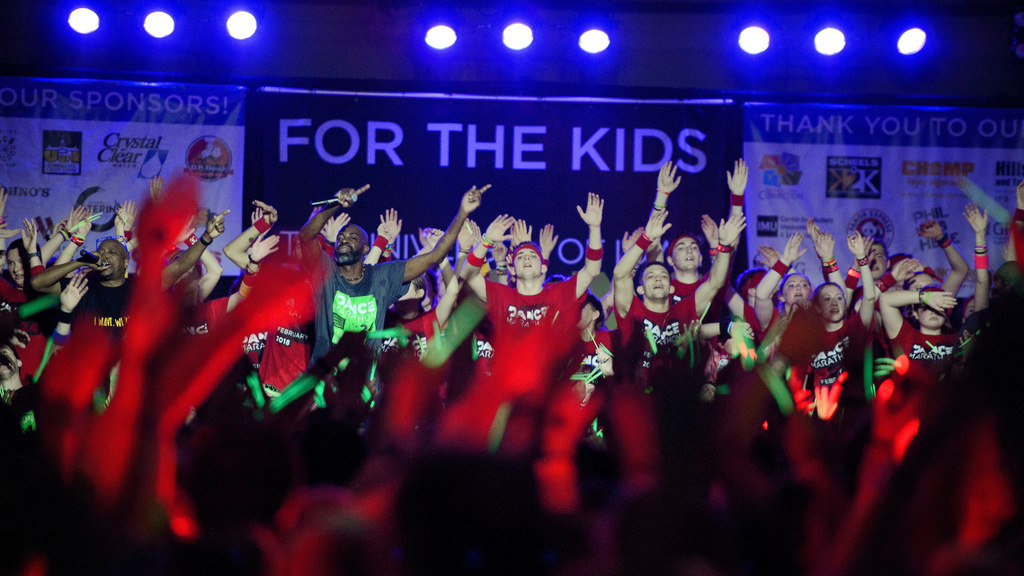
Since it began in 1994, University of Iowa Dance Marathon has raised more than $37 million to support youth cancer patients and their families at UI Stead Family Children’s Hospital, where the 11th floor is named the UI Dance Marathon Pediatric Cancer and Blood Disorders Center. Student participants not only raise money for the kids (or “FTK,” as they say) and volunteer in the hospital, they also develop career skills and personal connections that last a lifetime.
Learning what care looks like
Earley says her work in Dance Marathon has helped narrow her interest in medicine to pediatric oncology. Like many Dance Marathon participants, she volunteers at the hospital, and that experience has allowed her to spend time around pediatric oncologists and develop a bedside manner. She recalls shadowing one physician who learned siblings’ names and asked about their lives, a detail that felt enormous after years of sitting in appointments where siblings are present but invisible.
For her, the organization’s story is ultimately about showing up — in ways both large and small. Over 32 years, students in Dance Marathon have raised more than $37 million, and this year’s organization includes more than 1,300 participants and some 1,500 families.
But the heart of Dance Marathon, Earley says, is measured in moments that can’t be tallied: a sibling card written on a Wednesday night, a child laughing through an activity, a parent taking a break because someone else is there, a student who stays — not for credit or for a photo, but because they care.
“The impact on families’ lives,” she says, “speaks for itself.”
Liz Pearson can attest to that. She is a North Liberty, Iowa, mother whose 11-year-old daughter, Penelope, was diagnosed with high-risk B-cell acute lymphoblastic leukemia in 2022 and is now in remission. She says being part of Dance Marathon, with support from volunteers like Earley, meant the whole family — including Pearson’s husband, Todd, and son, Theo — never felt alone.
“Cancer treatment can be so isolating and lonely, but we never really felt the full effect of that because Dance Marathon wouldn’t let us be lonely,” Pearson says. “The kids have these little hand-embroidered hoodies that some of the Dance Marathon volunteers made for them as a gift for Penelope’s end of treatment, and they got Penelope mouse ears to wear to Disney World. It’s the little things that we see every day that remind us that we had this huge group of people behind us the entire time.”
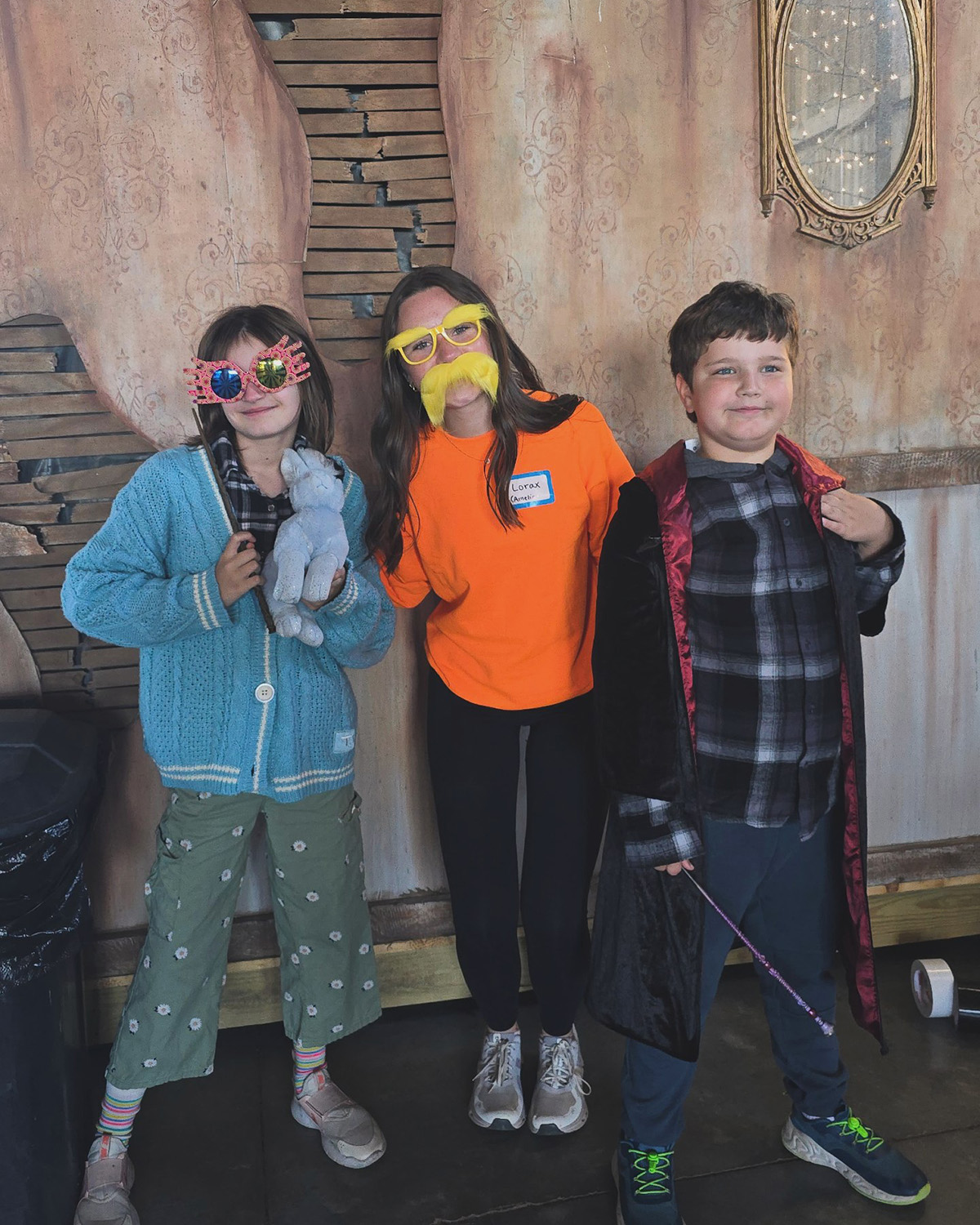
University of Iowa student Amelia Earley sports a "Lorax" look while hanging out with Penelope and Theo Pearson. Earley got to know the Pearson family through her role as UI Dance Marathon family liaison director. Penelope was diagnosed with high-risk B-cell acute lymphoblastic leukemia in 2022 and is now in remission.