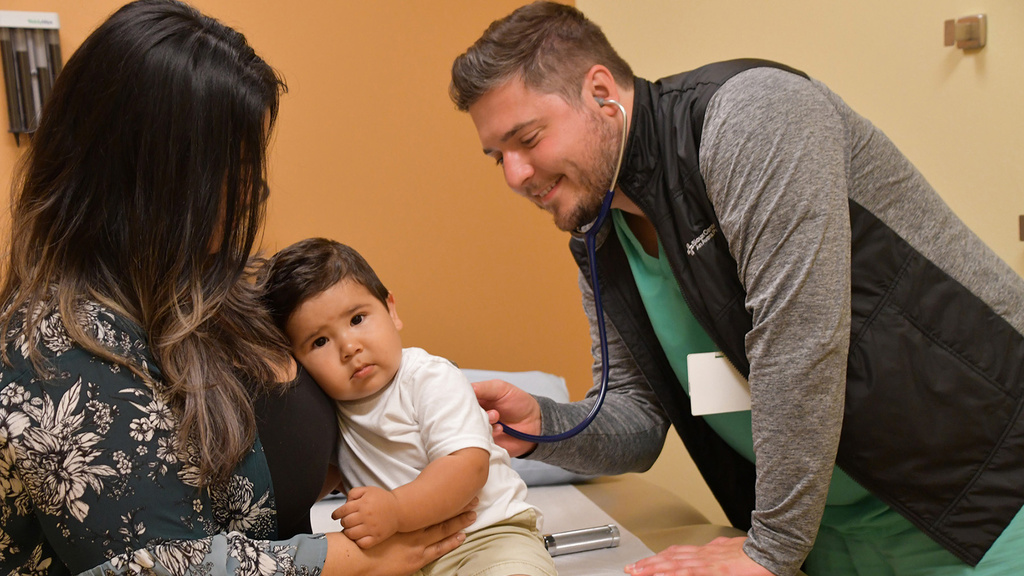
Magdalena Maginot, MD, came to Iowa for residency training. The Public Psychiatry Fellowship gave her reasons to stay — and a roadmap for improving the state’s behavioral health care system.
Story: Michael Anderson
Photography: UI Health Care Marketing and Communications
Published: March 26, 2026
Magdalena Maginot, MD, wasn’t planning to stay in Iowa. Everything changed, however, when she enrolled in the Public Psychiatry Fellowship (PPF), a new fellowship program offered by University of Iowa Health Care.
“I feel like this fellowship was a great addition in terms of recruiting workforce for Iowa,” Maginot says. “It certainly convinced me.”
Originally from Indiana, Maginot picked UI Health Care for her psychiatry residency for the program’s supportive environment and broad range of learning opportunities. Her experience in the Public Psychiatry Fellowship was so positive that it convinced her to put down roots in the Hawkeye State.
“The ability to kind of create my own adventure and really hone the skillset I want to have later, when I'm a practicing clinician on my own, has been phenomenal here,” she says.
“Dr. Maginot is awesome,” says Jodi Tate, MD, vice chair for education in the University of Iowa Department of Psychiatry. “She is wise beyond her years, and she’s committed to improving systems of care for vulnerable populations.”
Improving Iowa’s systems of care
Tate launched the fellowship in 2024. She hopes it will act as a vehicle to strengthen collaboration between Iowa’s psychiatrists and statewide health care stakeholders.
“With our increasing complex health care system, we need psychiatrists who can work collaboratively with key stakeholders to improve our overall behavioral health care system,” Tate says.
What makes the PPF unique, Maginot says, is the program’s focus on the overall systems of care within Iowa; how those systems work, how to navigate them, and how they might be improved upon.
Instead of dealing solely with a patient’s diagnosis, fellows in the PPF are taught to zoom out and examine how a patient’s specific experiences are impacted by the many interconnected systems that make up the continuum of care.
For example, in addition to psychiatric care, a homeless patient may also need help navigating substance use treatment, social services, Medicaid enrollment, and permanent supportive housing. Knowing how these systems work and how to advocate for patients within them is critical to achieving successful outcomes.
Tate says the goal of the fellowship is to improve health care outcomes for two groups: individuals who have complex health needs and underserved populations who receive health care in rural areas.
“This fellowship has really helped me solidify Iowa as a place I want to be because there's a lot of people who are change makers here.”
Bridging the gaps
Improving psychiatric care for vulnerable populations requires a robust understanding of the interconnected systems that their care is reliant upon.
“There are a lot of gaps in how we're able to provide care for people, and that's where patients start to fall through the cracks or start to feel like ‘a burden on the system,’” Maginot says.
The PPF has given Maginot the opportunity to work on bridging those gaps with mentors and partner organizations across the state who share her values and mindset.
“I love that through this fellowship I've gotten to meet other people who want to change the system and improve the system,” Maginot says.
The PPF has also exposed Maginot to the Collaborative Care Model. The model leverages telehealth to more closely integrate psychiatric care into a patient’s primary care. Under this model, a psychiatric consultant is able to provide care for up to eight times more patients compared to traditional methods.
About the Public Psychiatry Fellowship
Fellows in the PPF can choose to work rotations in metropolitan areas like the Iowa Medical Classification Center in Coralville and the Abbe Center for Community Mental Health in Cedar Rapids. The PPF also has rotation sites in rural settings like the State Training School in Eldora, the State Resource Center in Woodward, the Mental Health Institute in Independence, and the Mental Health Institute in Cherokee.
To be eligible for the PPF, applicants must either be a fourth-year psychiatry resident or have graduated from a psychiatry residency training program accredited by the Accreditation Council for Graduate Medical Education and be licensed to practice psychiatry in Iowa.
For her part, Maginot’s experience with the PPF has been so rewarding that it convinced her to stick around. Once she completes the PPF, the fourth-year psychiatry resident will remain at the university to complete a two child/adolescent psychiatry fellowship. She plans to remain in Iowa to build her career alongside other medical providers who share her commitment to improving the behavioral health care system.
“This fellowship has really helped me solidify Iowa as a place I want to be because there's a lot of people who are change makers here,” Maginot says. “They are willing to accept somebody else who's committed to that cause.”