
Using zebrafish, UI professor Colin Kenny studies uveal melanoma to better understand how it forms and spreads — and how it can be treated. His dedication to research comes from what he calls the “sheer thrill of discovery.”
Story: Madison Schuler
Photography: Liz Martin
Published: April 6, 2026
Colin Kenny’s research into a rare type of eye cancer started because he was struck by the limited opportunities for patients with uveal melanoma to receive lifesaving treatment, particularly for patients whose liver has become populated by cancer cells.
Kenny, assistant professor of surgery–surgical oncology and endocrine surgery in the University of Iowa Carver College of Medicine, gravitated toward genetics as his primary interest early in his career. He questioned why some people respond better to cancer therapies: Is it due to the patient’s own biology, the cancer’s inherent susceptibility, or perhaps both?
“The differences between people are what interested me, and that’s what first drew me to genetics.” says Kenny, who grew up in Ireland.
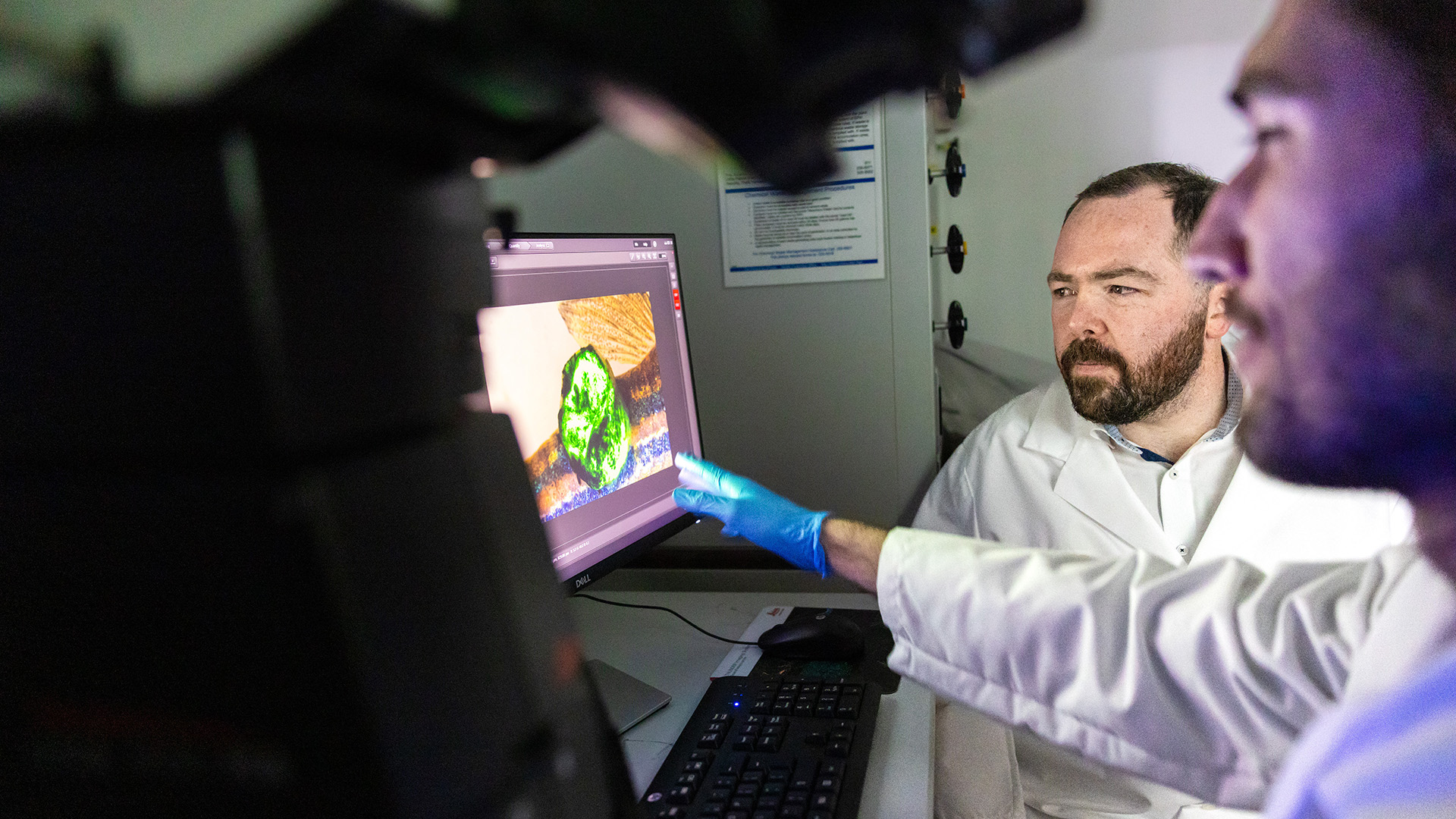
“I want patients to know that we’re doing research to understand the biology of their tumors and to reduce their aggressiveness,” Colin Kenny says. “My aim is to shrink tumors so that patients can live with them and regain a normal, healthy life. That is the goal.”
What began as curiosity about genetic differences has now evolved into a quest to understand a very specific cancer. Kenny seeks to unravel how and why uveal melanoma — a rare eye cancer that develops from melanocytes, the pigment-producing cells in the skin and eyes — occurs and how it can be treated.
Kenny uses zebrafish to study the disease because they mature rapidly and are transparent in early life stages, making it possible to observe how cancer develops and reacts to treatment. Zebrafish also have the same genes that control melanocyte and eye development as humans, which makes them a useful analog to study uveal melanoma.
“The sheer thrill of discovery — knowing something that I didn’t know yesterday that I know today — that’s what keeps me in research,” Kenny says.
That thrill grew during his graduate studies, when a single zebrafish significantly affected Kenny’s research. The specimen Kenny studied lacked melanocytes due to a mutation in MITF, a master regulator of the melanocyte lineage, and when exposed to melanoma-causing mutations, the fish never developed the disease. Meanwhile, its siblings, which contained normal melanocytes, did.
“It was such an impressive phenotype — deleting one single gene from an animal prevented it from getting one of the worst diseases,” Kenny says. “That one observation taught us so much about melanoma.”
Interested in medicine?
The Roy J. and Lucille A. Carver College of Medicine is a highly ranked medical school where students learn to become accomplished clinicians and top-flight researchers and educators.
Students come to Iowa to study medicine in a program that emphasizes problem-solving skills, case-based learning, and community experiences — a foundation that provides focus and direction for tomorrow’s providers in a future that cannot be easily predicted.

After earning his graduate degree in Ireland at Trinity College Dublin in 2017 and spending a brief time there as a postdoctoral researcher, Kenny joined the University of Iowa, where he emphasizes mentorship, discovery, and improving outcomes for patients in every step of research.
Kenny shares how his lab has grown, what drives his research, and what the future may hold for patients with uveal melanoma.
Why did you decide to focus on melanoma?
Something very specific with this one animal just taught us so much about the disease. There are genes that regulate its onset.
Why do you use zebrafish?
We use zebrafish because the melanocyte development — the genes that are turned on to make the pigment — are the exact same in humans, and that’s why we use them as a model for training people. They’re fantastic for drug discoveries: We can give a fish a human patient’s tumor and watch the tumor grow and see which drug works best to treat it. The goal is to translate that back to the clinic.
What impact do you hope your research will have for patients or other researchers?
I want patients to know that we’re doing research to understand the biology of their tumors and to reduce their aggressiveness. My aim is to shrink tumors so that patients can live with them and regain a normal, healthy life. That is the goal.
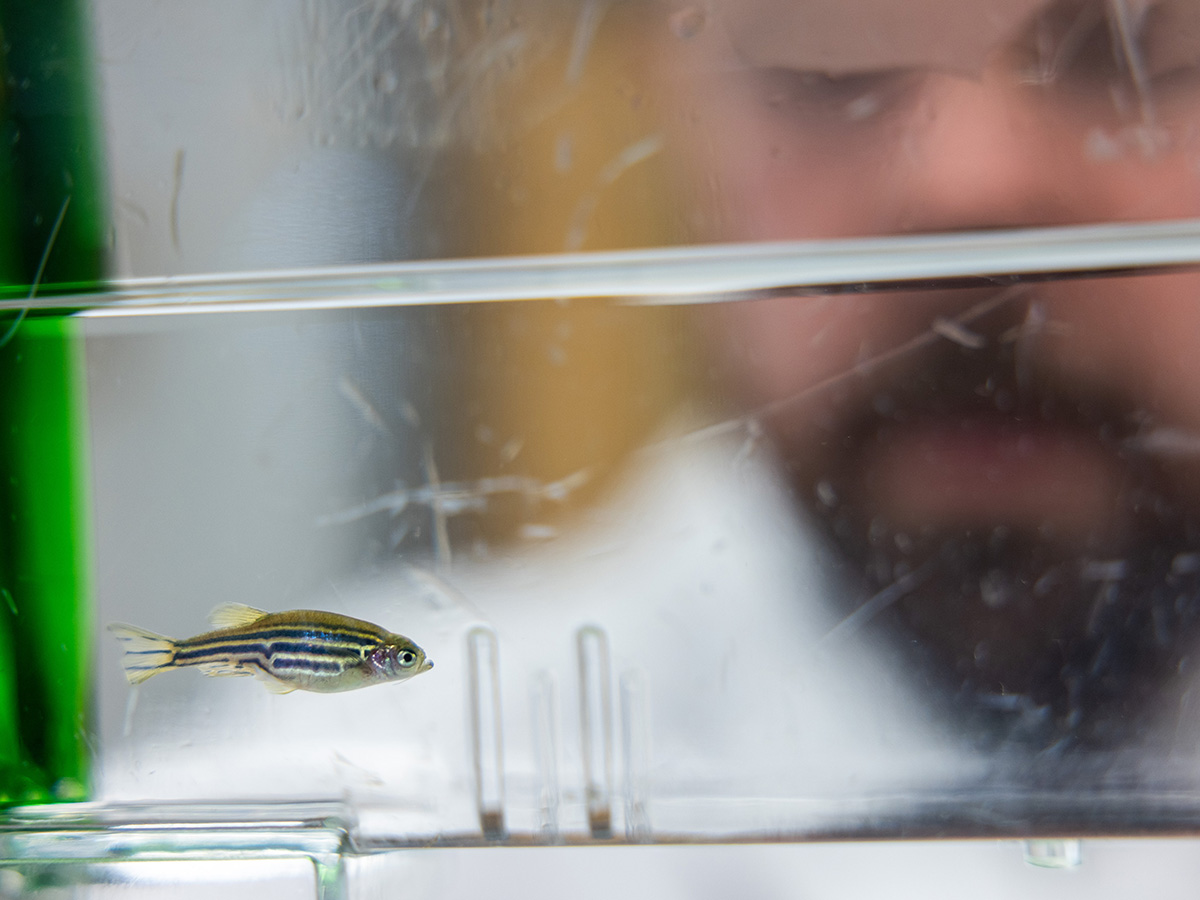
Using zebrafish, Dr. Colin Kenny studies uveal melanoma to better understand how it forms and spreads — and how it can be treated.
What has surprised you the most or been your biggest challenge?
I think we probably fail 80–90% of the time. But that’s not really failing. A failed result is a result. It is not a dead end. Learning to fail and to get back up, I think that also teaches an important lesson.
Which accomplishments or moments are you most proud of?
We were the first to establish a uveal melanoma model in the eye of a single fish. While other labs have studied uveal melanoma in live fish, their models produce tumors throughout the body. In contrast, we pioneered targeted gene delivery directly to the eye, allowing us to study a single, localized melanoma. This has important implications for studying the tumor microenvironment, since the eye is where humans develop the most aggressive forms of this disease, and we know that the normal cells surrounding the tumor can influence its behavior.
As an early-to-midcareer researcher, what has it been like building your lab and furthering your career?
When I started, I had an empty space and no staff. My first step was to hire a lab manager. Together, we established the zebrafish colonies and acquired essential equipment. I then took on my first graduate students, and each mentored an undergraduate. Our lab currently includes five undergraduates, three graduate students, and surgical residents, all contributing to different projects. It’s been challenging but incredibly rewarding to see the lab grow and thrive.
How would you describe the work your lab does? What makes it unique or distinctive?
I spend a lot of time focusing on how to better students. I take time to help them think critically and ask hypothesis-driven questions. We spend a lot of time adapting how to set up an idea, how we know an idea is good, how you know an idea is ready for this time, and how can we address that idea with our current system. From an experimental standpoint, we understand how normal cells become cancers and how a different person’s body shapes how aggressive that cancer is going to be, and then ultimately, we uncover drugs that are specific for the patient and their specific cancer type within melanoma.
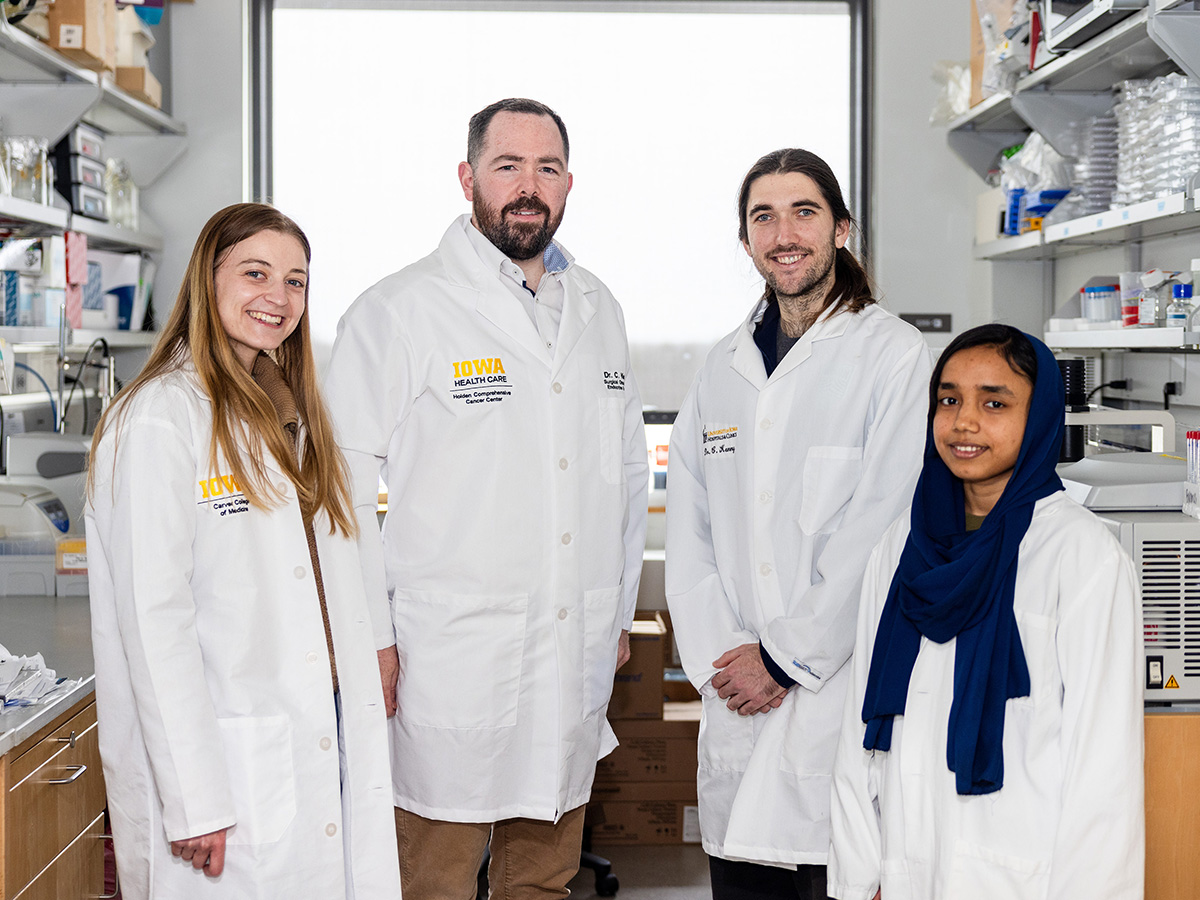
Colin Kenny (second from left) stands with researchers (from left) Delaney Robinson, Julius Yevdash, and Sanjida Dorin.
What led you to the University of Iowa?
I came to Iowa first for a postdoctoral position then returned because of the Cancer Center’s strong focus. We have many world-renowned investigators — Drs. Ronald Weigel, Adam Dupuy, Christopher Stipp, Mohammed Milhem, James Byrne, Elaine Binkley, Robert Mullins, and Budd Tucker — from whom I wanted to learn. My wife, Dr. Kelly Mulfaul, also got a job as an assistant professor in the Department of Neuroscience and Pharmacology as well as the vision institute, so Iowa offered a unique environment where we both could continue our careers. There is no greater feeling than being able to collaborate with my wife on projects related to eye disease, working together to help patients survive and live with devastating conditions.
How has the University of Iowa’s research environment or resources shaped your work and the direction of your lab?
What has stood out to me at the University of Iowa is the deep culture of collaboration. When I started my lab, my chair at the time, Dr. Weigel, generously offered half of his research space so I could hire staff and get started. That moment made me realize I was in the right place — selfless support from leadership like this set the tone from day one.
Iowa provides the infrastructure and resources to move rapidly from bench to bedside. Our research is impactful because we collaborate closely with clinicians and surgeons. We also work with other labs and researchers on projects, such as mechanisms, melanoma resistance and recurrence, and immunology and radiation protection in the eye, creating a truly interdisciplinary environment that bridges basic science and patient care.
The zebrafish research community worldwide is equally remarkable. Researchers freely share zebrafish lines across the globe, enabling labs like ours to expand colonies and advance experiments more efficiently.
What upcoming projects are you most excited about?
We study melanoma by looking at both cancer cells and the environment around them. Melanoma begins in melanocytes — the cells that give rise to this cancer — but these cells can behave differently depending on where they are in the body. In the skin, melanocytes can become cancerous due to sun exposure, leading to cutaneous melanoma. In the back of the eye, similar cells give rise to uveal melanoma. Even though these cancers start from the same type of cell, they behave very differently. Our lab is interested in understanding whether these melanocytes are inherently different or whether their surrounding environment makes them behave differently.
One exciting new project is studying how fibroblasts — normal support cells — change during uveal melanoma development and begin to promote tumor growth. These cells can reshape the tumor’s surroundings and release signals that help cancer cells survive and spread, especially to the liver. We hope to use this knowledge to develop new ways to target these supportive cells in treatment.
We’re also investigating whether some melanocytes in the eye take on features similar to embryonic cells, early-stage cells that are naturally fast-growing and migratory. While these traits are important during development, they may also make these cells more likely to form uveal melanoma. We want to study these unique cells so we can better understand their role in uveal melanoma.
Finally, we study how melanoma cells can switch between different behaviors — either focusing on growing quickly or on spreading to new parts of the body. Both of these strategies help the cancer progress, and we want to understand the internal signals that control this switch so we can better target melanoma with new treatments.


