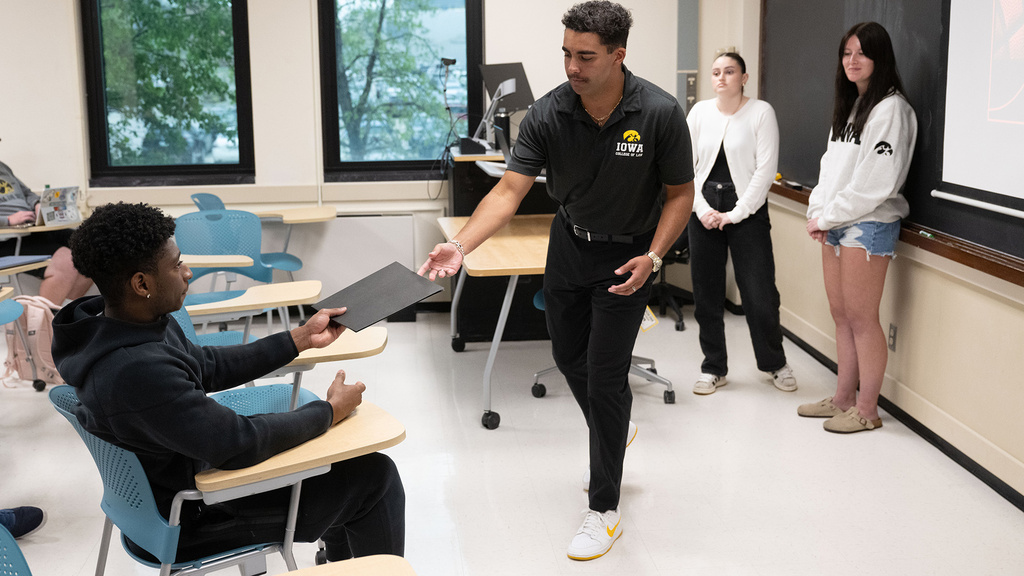
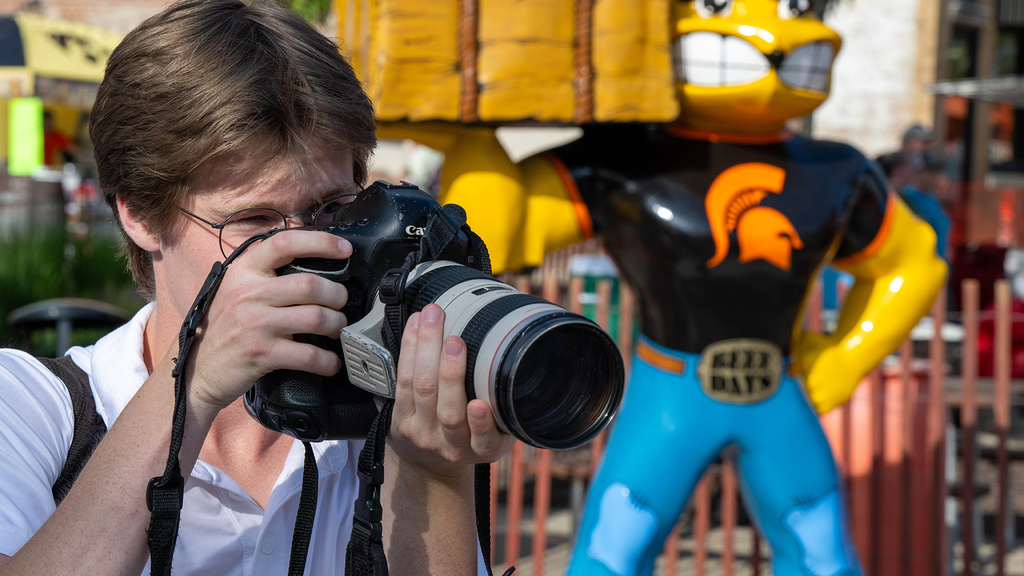
In a high-pressure mock NFL draft, University of Iowa students used analytics, teamwork, and quick thinking to make real-time decisions — and experience the chaos of draft day firsthand.
Story: Emily Nelson
Photography: Justin Torner
Published: April 22, 2026
On a mid-April morning, the studio for Daily Iowan Television felt less like a university newscast and more like an NFL draft floor.
“From here on out, you are not students pretending to be the teams,” announced Adam Kempenaar, professor of practice in the School of Journalism and Mass Communication and the Sport and Recreation Management Program at the University of Iowa. “You are the management representing the teams. No more ‘they.’ It’s ‘we.’”
Moments later, the Las Vegas Raiders were on the clock.
“With the first pick of the 2026 NFL draft, the Las Vegas Raiders are happy to select Fernando Mendoza, quarterback, Indiana University.”
The picks came quickly. Analysis followed. Cameras rolled. Reporters circled.
For students in Sports Analytics for Decision Makers, this wasn’t just a class exercise — it was a full-scale simulation of one of sports’ most scrutinized decision-making events.
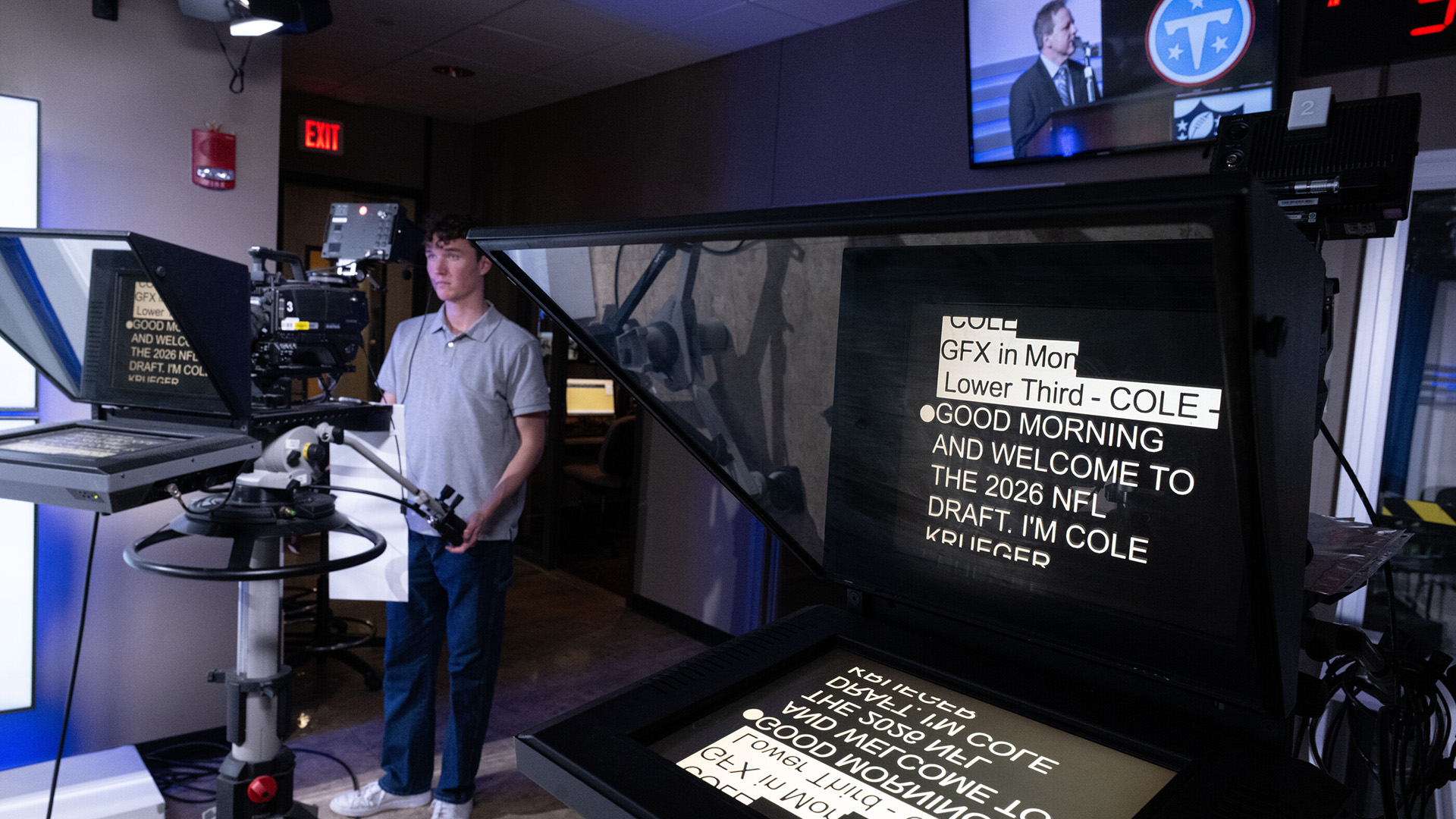
University of Iowa students produced the mock NFL draft as a live broadcast in the studio of Daily Iowan Television.
More than just numbers
Kempenaar, former vice president of marketing and content for the NHL’s Chicago Blackhawks, designed the course around a simple premise: Analytics matter most when they inform decisions.
“I don’t have a stats degree or a math degree, but I was a decision-maker, and I relied heavily on analytics to make decisions,” Kempenaar says. “It’s about understanding what the numbers mean and how they can be translated into insights that lead to actionable decisions.”
While the course is rooted in analytics, students quickly learn that it’s not just about data — it’s also about interpretation.
Hannah Howard, a second-year student from Ankeny, Iowa, pursuing a BS in data science with a minor in sport and recreation management, said one of the biggest surprises was how much the class focused on storytelling.
“Being in data science, I’m always working with numbers and statistics and modeling, but we haven’t explored that aspect as in depth as I have in this class,” Howard says. “We participated in a baseball arbitration project, and a lot of that was turning data into headlines and trying to convince people of a certain narrative with those statistics.”
That storytelling skill has already proved valuable. Howard says she discussed the course in a recent internship interview, highlighting how it taught her to translate complex data into clear insights.
“It’s not just about generating numbers,” Howard says. “It’s about telling people what those numbers mean.”
Cal Johnson agrees. The third-year student from Ankeny is working toward a BBA in finance and risk management and insurance with a minor in sport and recreation management.
“This is very applicable not just in sports, but in many other fields,” Johnson says. “Is there a better way to measure this? Is there a better stat? How can we best explain this to a CEO or other official?”

Ryan Cassidy, Sergio Gonzalez Icaza, and Nile Eddy, who played roles in the New York Jets’ organization for the mock draft, announce their pick of Arvell Reese, a linebacker from Ohio State, during a live broadcast in the DITV studio.
Inside the war room
Students were divided into front offices, each representing an NFL franchise. Armed with draft boards, scouting reports, and data, they evaluated prospects and made picks in real time.
Some selections followed expectations.
After projecting the first overall pick as a “shoo-in,” Sergio Gonzalez Icaza, a third-year sport and recreation management student from Mexico City who helped run the New York Jets’ draft room, says his group had to weigh immediate impact versus long-term potential.
“We thought more about the team situation,” he says. “Arvell Reese, a linebacker from Ohio State, had that raw talent — the kind of guy you can develop.”
Other selections required quick pivots. The weekend before the draft, a trade meant the New York Giants now had the fifth and 10th overall picks. Howard, who had the role of general manager for the Giants, says her group had to scramble but felt ready.
“Because we had done so much prep, we knew who our guys were,” Howard says.
Even with preparation, the speed of the simulation forced quick thinking.
“It went really fast,” Johnson says. “But it was fun — you get a little nervous, and you have to pivot when your top guys are gone.”
That pressure is an intentional part of the class.
“It heightens the reality,” Kempenaar says. “You have to be able to make decisions under pressure.”
Still, for many students, the pressure only added to the excitement.
“It was great to be part of that chaos you always see on TV,” Gonzalez says. “Getting these kinds of experiences is exactly why you come to Iowa. And it’s exactly why I study what I study.”

University of Iowa student Hannah Howard, who played the role of general manager for the New York Giants, answers questions in the Daily Iowan newsroom from student sports writers after her group's pick in the first round of a mock NFL draft.
Bringing diverse fields together
The class drew students from a range of majors — from sport and recreation management, to finance, to data science — mirroring the collaborative nature of professional sports organizations.
“I worked more with the numbers,” Johnson says. “But others were really good at putting that into a sports context and what it actually means.”
That collaboration was intentional.
“You shouldn’t be making decisions in a vacuum,” Kempenaar says.
Howard saw that play out firsthand.
“Everyone brings different strengths,” she says. “Some people are great with data; others are better at turning it into a story. Seeing that come together has been a big part of the class.”

University of Iowa students Cole Krueger and Elise Gan host a broadcast of the mock NFL draft in the DITV studio. Gan says participating in opportunities like this "helps me see what this would be like in the real world. And it makes me think, ‘Wow, I could actually do this.’”
The full draft experience
The simulation extended beyond the picks themselves.
Journalism students covered the draft under real deadlines. Broadcast students produced a live show, breaking down selections and analyzing team needs.
“I was up until 1 a.m. preparing,” says Elise Gan, a third-year journalism and sport media and culture student from Northbrook, Illinois, who co-hosted the broadcast with fellow student Cole Krueger. “Looking at mock drafts, team needs — trying to explain more than just about the player, but how they fit.”
For Gan, the experience pushed her outside her comfort zone.
“People who don’t work in TV don’t understand how long two to three minutes is when you have to fill time and just talk and banter and improv,” she says. “But it helps me see what this would be like in the real world. And it makes me think, ‘Wow, I could actually do this.’”
Meanwhile, students in a sports writing class approached the event like a real draft, swarming the “general managers” to ask questions after each pick and racing to meet deadlines.
“This is about getting information out quickly and efficiently,” says Wayne Drehs, visiting associate professor of practice in the School of Journalism and Mass Communication. “What happened? Why did it happen? What does it mean?”
Kempenaar says he enjoys bringing in and working with other instructors and students.
“I have students in my class who want to be GMs or work in sports for a team someday, but there are also students who are going to be reporters or broadcasters or producers,” Kempenaar says. “And they otherwise might not get a chance to put on a show like this. I just love that synergy between the different groups and that we’re all getting something out of it.”

University of Iowa students taking the class Sports Analytics for Decision Makers watch a live feed while waiting their turn to make their pick in a mock NFL Draft in the Daily Iowan newsroom.
From simulation to reality
After two days of mock draft, students will be able to head home to watch the real NFL draft unfold.
“We just went through this process and put ourselves in their shoes,” Kempenaar says. “And now we get to see what the teams actually do — and decide whether we agree.”
Howard notes that some players widely projected as top picks didn’t go as expected in the simulation, raising questions about how real teams will approach the same decisions.
“It’ll be exciting to watch it through that lens,” she says.
For a few hours, though, the decision was theirs. That glimpse into the real world of sports — fast, uncertain, and relentlessly on the clock — is exactly why the students signed up.
“We’re not just sitting in a classroom writing and reading. We are doing the prep, going into a studio, calling out a pick, and then defending our pick,” Gonzalez says. “It’s giving me confidence so when I go into a workplace, I know I’ve accumulated enough experiences here at Iowa and with these sorts of classes that I feel like I can make an impact immediately.”