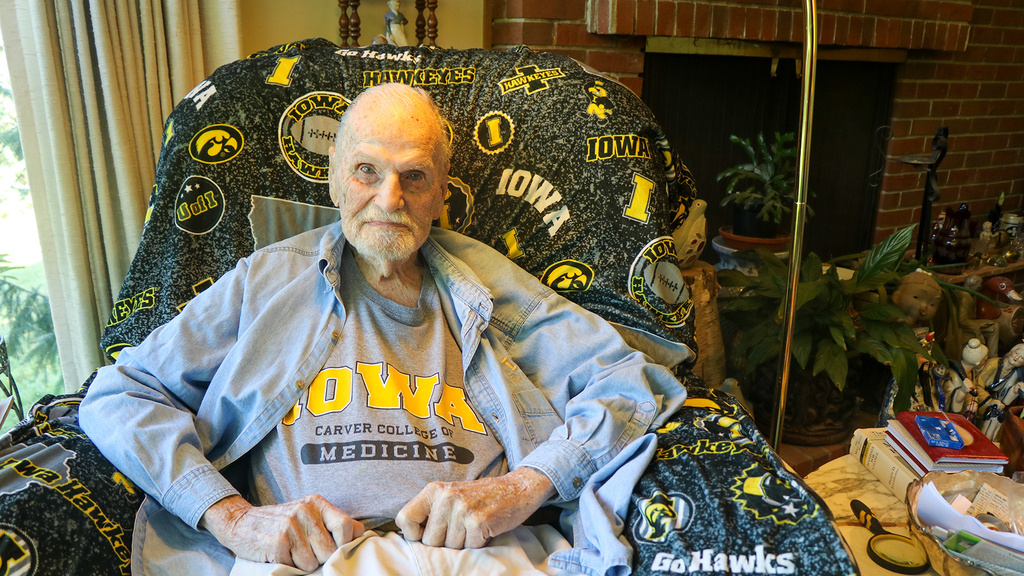
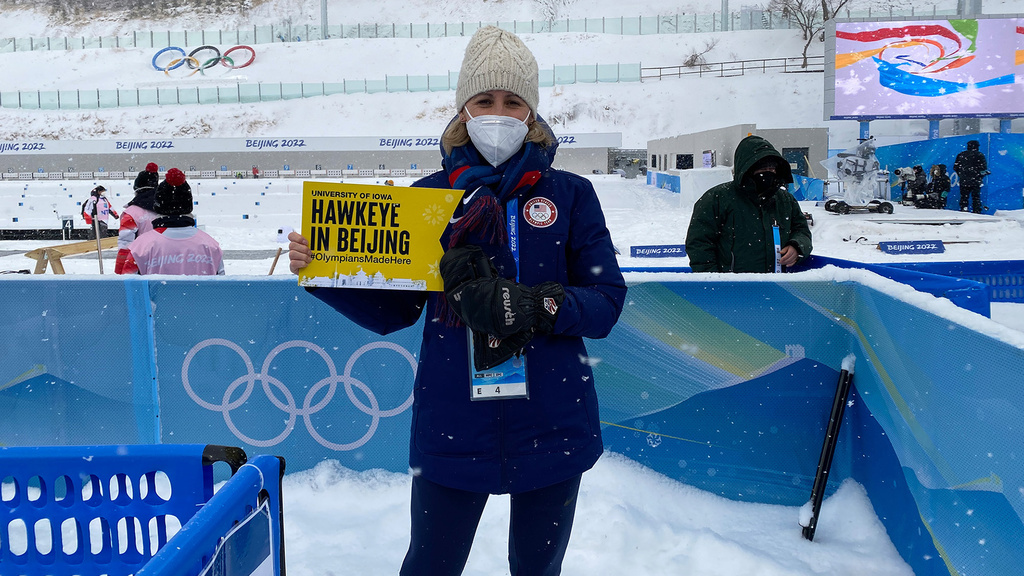
Before leading some of NASA’s most ambitious missions, Jim Green found his trajectory at the University of Iowa — where a series of “gravity assists” set him on a path to the stars.
Story: Emily Nelson
Photography: Justin Torner and Jill Tobin and courtesy of Jim Green
Published: April 28, 2026
In spaceflight, a gravity assist allows a spacecraft to reach distant places much faster by borrowing momentum from a spinning planet and to alter its direction by using the planet’s gravity to change its trajectory.
For Jim Green, who retired in 2022 after more than 40 years at NASA, including the last three as its chief scientist, that same concept applies to his life.
“Something happens to you — whether it’s a person, place, event, even a book — that inspires you, and you get so excited that you change direction and accelerate in a new direction toward a new goal,” Green says.
Over the course of his career, Green has experienced many of these “gravity assists.” And he can trace several of those back to one place: the University of Iowa.

Jim Green gestures from the roof of Van Allen Hall during a recent visit to the University of Iowa campus. Green counts the building's namesake, James Van Allen, and Don Gurnett as invaluable mentors during his time as a student at Iowa.
Gravity assist No. 1: A trajectory set in motion
Today, Green is known as one of NASA’s most influential scientists. But before he helped guide billion-dollar missions to Jupiter, Pluto, and Mars, Jim Green was just a kid from Burlington, Iowa, spending his days on the river catfishing and waterskiing.
His turning point came in high school, when his chemistry teacher, Don Vinson, took a summer astronomy course at the University of Iowa. Vinson then began offering an after-school astronomy class — which included access to a 12-inch Alvan Clark refracting telescope built in the 1930s and later donated by the owner to Burlington High School.
Green didn’t just observe the night sky; he taught himself astrophotography and built instruments that allowed him to use the telescope to photograph planets. His images were even published in the magazine Sky & Telescope.
“By the end of my high school career, I knew exactly what I wanted to do,” Green says. “I had my gravity assist. I was going to be an optical astronomer.”
That clarity pointed him directly to Iowa.
“It was always going to be Iowa,” Green says. “There was one reason for that. And that was James Van Allen.”
Feeling the power of Artemis
For someone who spent decades shaping NASA missions, Jim Green still found himself in awe watching Artemis II launch in person. The rocket, which sent astronauts around the moon for the first time in more than half a century, took off April 1, 2026, from Cape Canaveral, Florida.
First came the light — an intense flash as the rocket engines ignited. Next, a little pressure wave: “Your hair gets blown back a little bit.” Then, a moment later, the sound arrived. And finally, the ground began to shake.
Watching from the stands, the experience was more than just visual — it was physical. The structure beneath him amplified the force of the launch, turning it into a full-body event.
“The best place to be is at the top of the stands because the whole thing starts shaking,” Green says. “It’s like going to an Iowa game and the stands are rocking because of all the people. But in this case, it’s not the people, it’s the rocket doing that.”
Gravity assist No. 2: Finding a mentor in a space legend
Green’s first science course at Iowa was Astronomy 101, held in a big room filled with at least 300 students. The course instructor was James Van Allen, a pioneering American space scientist and physicist at the University of Iowa best known for discovering the Van Allen radiation belts surrounding Earth.
“Of course, I knew who he was,” Green says. “It was tremendously exciting to have Van Allen teach my first-semester class.”
The next semester, Green signed up for a class titled Readings in Astronomy. It was to be taught by “staff,” which he assumed meant a graduate student.
Green showed up at the assigned room in Van Allen Hall and found it full of computer printouts, data tapes, books, and other clutter.
“I’m thinking I’m in the wrong place when James Van Allen leans his chair back from behind a bookcase and says, ‘Come on in, Jim, this is my office,’” Green says. “It turns out I was the only student. This was gravity assist number two.”
Green told Van Allen about the astrophotography he had done and brought in a collection of 35mm images of the sun that he had taken every day for six months.
“He goes, ‘This is fantastic. Let’s do some research on this data,’” Green says.
Green found himself conducting original scientific analysis on sunspot rotation — work that introduced him to the rigor and excitement of discovery.
“I was hooked,” he says.
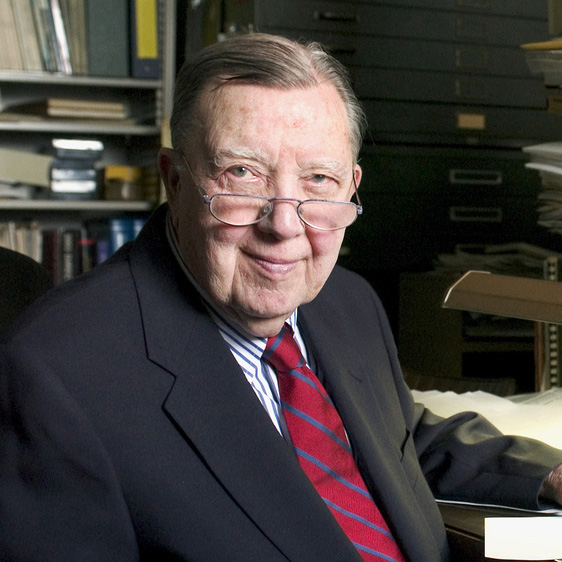
James Van Allen
Gravity assist No. 3: A second mentor and a stint as a computer operator
Green says he found something rare at the University of Iowa: a program where students weren’t just learning about space — they were actively participating in it.
“Students are building instruments, they’re doing the testing, they’re learning the business,” Green says. “The longer I was there, the more I got involved in the spacecraft end of it.”
The real switch to the space program came after Green got a BA in astronomy and stayed at Iowa for graduate school, realizing that he could do the astronomy he wanted to do but from spacecraft rather than telescopes.
“I switched advisors from the optical astronomer in the group to Dr. Don Gurnett, one of my favorite undergraduate teachers, and became his research assistant,” says Green, who went on to earn an MS in physics in 1976 and a PhD in physics in 1979. “Don was my next gravity assist.”
Gurnett was a pioneer in the field of plasma wave research. His discoveries and achievements included solving how radio auroras are created, providing the first detailed measure of radio emissions from the outer planets, and informing humankind of the first spacecraft to leave the solar system and reach interstellar space.
During this time, Green — who was trying to make ends meet — took a position as the 4 p.m. to midnight computer operator in the physics department, which had three “fast” Univac computers. It wasn’t unusual for the midnight to 8 a.m. operator to call in sick, so Green would work that shift, too.
“By 3 a.m. I would be done with everything I had to do, so I would work on my own programs and run them on the computers,” Green says. “I developed a series of modeling capability in which I created programs that did three-dimensional ray tracing in anisotropic magnetospheres. And that’s what I became known for in my early career. And it was all because I had these computers at my beck and call.”
Green, who as a teaching assistant would take or teach classes all day, work in the computer room from 4 p.m. to 8 a.m., and then head back to class, says he slept whenever he could.
“But I was having a ball.”

Finding balance in the past
For all the high-stakes decisions Jim Green made at NASA — overseeing billion-dollar missions and testifying multiple times before Congress — his way of managing stress had nothing to do with space.
Instead, due in part to his solid liberal arts degree, he turned to history.
At home, Green would set aside planetary science and immerse himself in Civil War studies, a lifelong passion sparked by a book his grandmother gave him as a child. Eventually, that interest grew into active involvement as a Civil War reenactor, where he portrays a member of the Union Army’s balloon corps.
The contrast helped put his work in perspective.
“At the end of my reading, I think, ‘Oh my God, I am so glad I didn’t live in the 1860s,’” Green says.
Compared to the realities of war, even the pressure of leading NASA’s planetary science division felt manageable. He says that mental reset was key to his longevity.
“This job is so much easier than Pickett's Charge,” Green says. “It enabled me, when I got up in the morning, to be refreshed and be excited about solving that next big problem and make that next decision.”
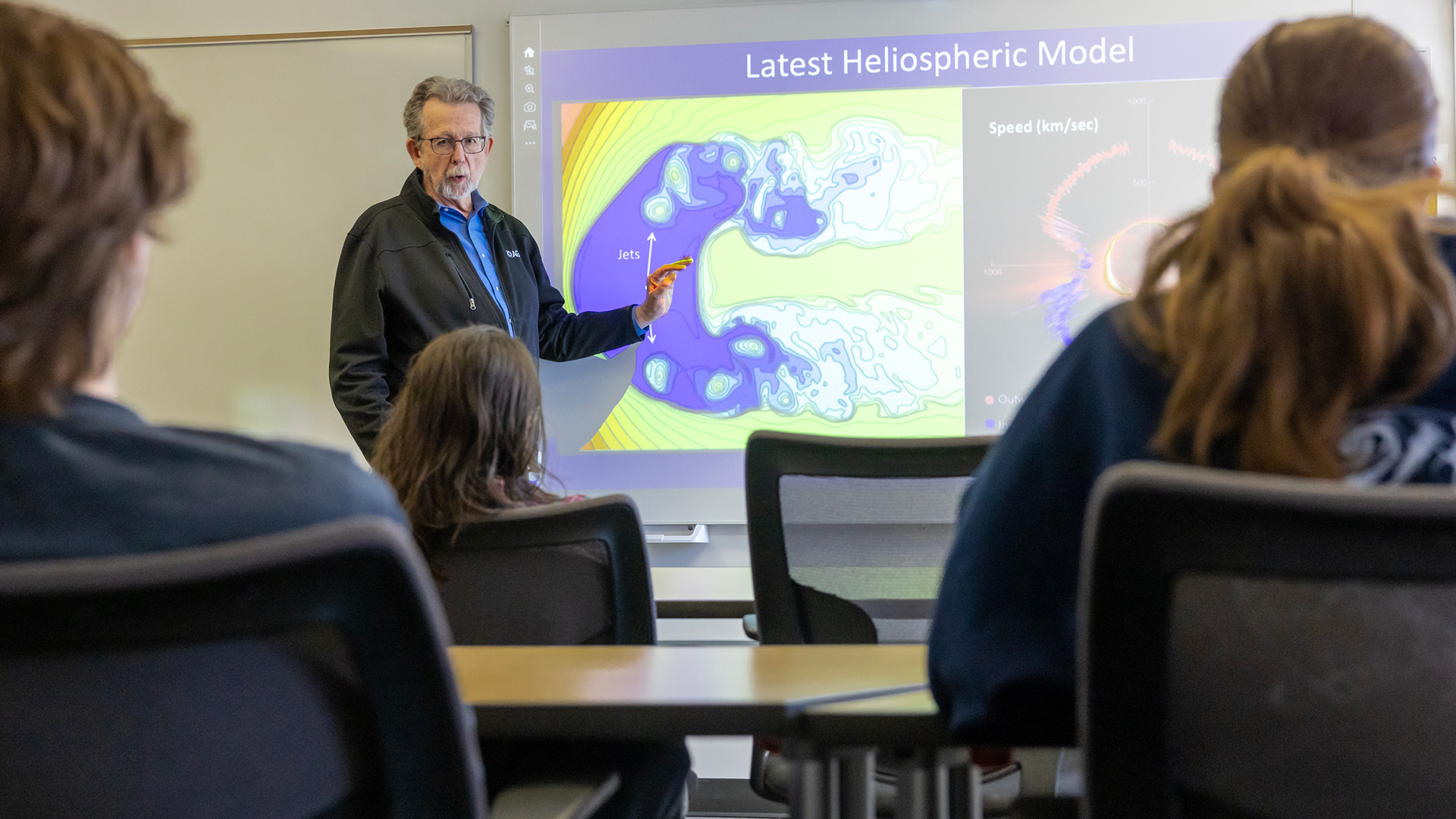
“If I had one wish, I wish that I was graduating from the University of Iowa now,” Jim Green says. “Because over the next 50 years, today’s students’ careers are going to be nothing but one unbelievable worldview-changing discovery after another.”
Gravity assist No. 4: From Iowa to NASA
Gurnett encouraged his students to present their research at national and international conferences. Green took that advice to heart.
“It’s a real rush to discover something no one in this world knows but you,” Green says. “And these conferences give you an opportunity to relay that and to get other people excited about it.”
By the time he completed the PhD in 1979, Green had given 18 conference presentations and received multiple job offers. These included positions at NASA’s Goddard Space Flight Center in Maryland, which at the time was known as a science center, and Marshall Space Flight Center in Alabama, which was known as a rocket center.
He chose Alabama — a decision that surprised many people. But the Space Shuttle was just coming online, and Green was attracted to the science that would be done aboard the spacecraft.
“Marshall Space Flight Center was responsible for a lot of shuttle work, and they needed a science team to work directly with the scientists who were building the experiments,” Green says. “It was the difference between being a small fish in a big pond or being in a pond of equals. I decided I wanted to help establish a group and not be part of a group that had already been well established. It was the best decision I ever made.”
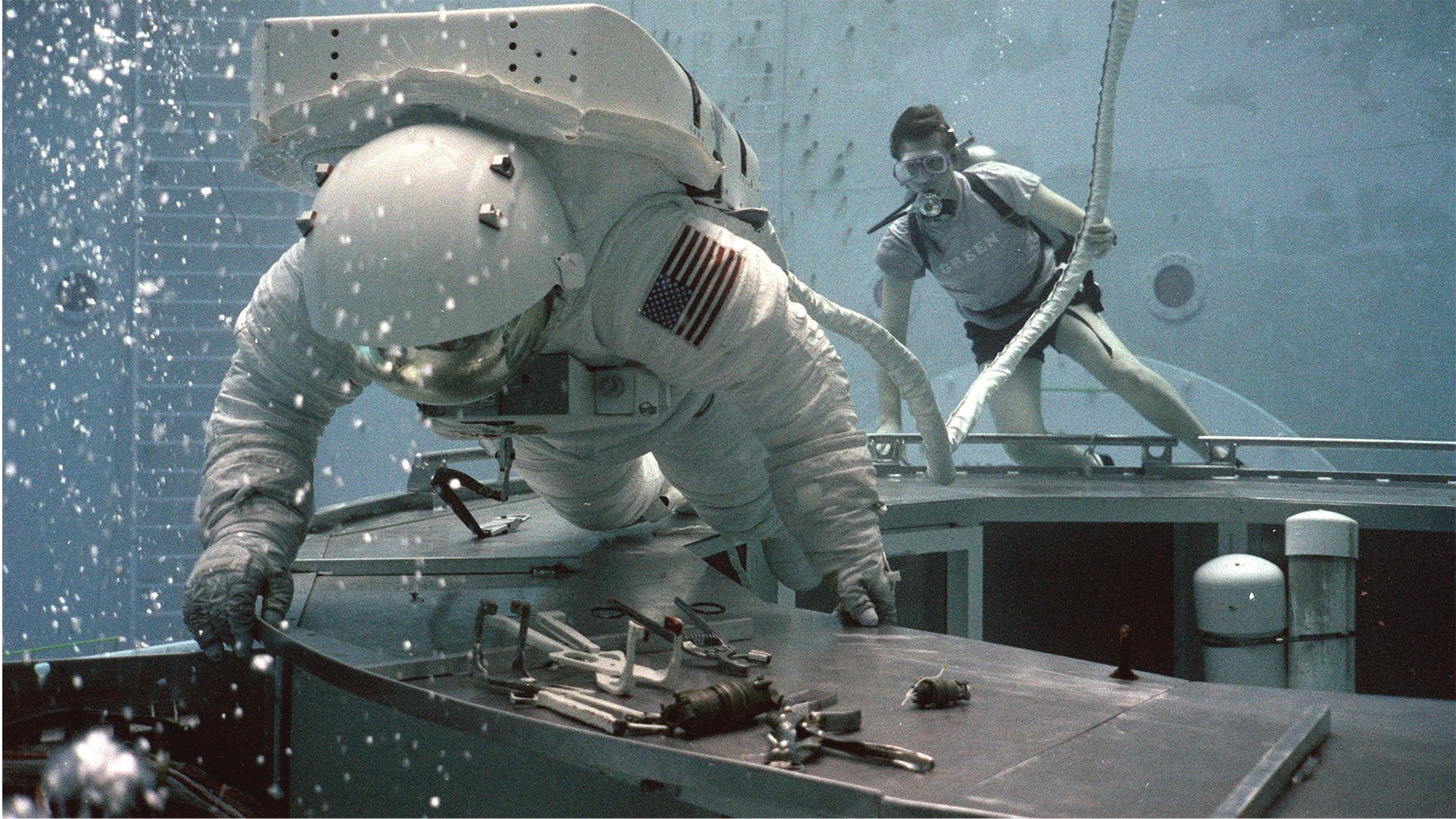
Growing up along the Mississippi River in Burlington, Iowa, Jim Green loved spending time in the water. That love deepened as an Iowa student, where he became president of the University of Iowa Scuba Club. In his first year with NASA, he became a safety diver; he made more than 150 dives and saved two lives in the position.
It was also at Marshall Space Flight Center that Green put a unique skill he had gained at Iowa to use.
“One of my early U of I roommates was a scuba diver. And he said, ‘You’ve got to learn to scuba dive,’” Green says. “Growing up as a river rat, I loved the water, and I loved diving so much I ended up being the University of Iowa Scuba Club president.”
During his first year with NASA, Green saw an advertisement in the Marshall Space Flight Center newspaper seeking divers. He applied and was hired as a safety diver in the Neutral Buoyancy Simulator supporting NASA’s crewed spaceflight program.
“It was in the tank that the astronauts would practice what they were going to be doing in space,” says Green, who made more than 150 dives and saved two lives in the position. “They’re repairing the Hubble Space Telescope. They’re building the International Space Station. They’re assembling structures. They’re running around in the manned maneuvering unit. I just had a blast.”

Jim Green speaks fondly of the University of Iowa, his alma mater. “Iowa set me up to figure out how to teach myself,” he says. “I became a lifelong learner.”
Launching the next generation
During his four decades at NASA — including 12 years as the director of the planetary science division and three as the agency’s chief scientist — Green oversaw missions across the solar system, including the New Horizons spacecraft flyby of Pluto, MESSENGER spacecraft to Mercury, Juno spacecraft to Jupiter, Grail A and B spacecraft to the moon, Dawn spacecraft to Vesta and Ceres, Cassini probe to Saturn, and the landing of the Curiosity rover on Mars. For his planetary work, the science community honored him by naming asteroid 25913 Jamesgreen.
He also contributed to more than 125 scientific papers and received numerous awards, including NASA’s Exceptional Achievement Medal and its Distinguished Service Medal, and Japan's Kotani Prize in recognition of his international science data management activities.
And in 2015, Green served as a scientific consultant to director Ridley Scott while filming The Martian.
Now retired, Green teaches students around the world about space and planetary science in the metaverse and leads a private consulting firm.
Green says his success was built not just on technical skill but on habits formed in Iowa.
Among them: relentless curiosity and communication.
“Iowa set me up to figure out how to teach myself,” he says. “I became a lifelong learner.”
He also embraced storytelling in science, a skill he honed during graduate school presentations and later used to bring the public into NASA’s biggest moments — like broadcasting the Curiosity rover landing live.
“Science isn’t done until you share it,” he says.
Green says the world has witnessed a golden age of planetary science, but he is looking forward to what comes next.
“If I had one wish, I wish that I was graduating from the University of Iowa now,” Green says. “Because over the next 50 years, today’s students’ careers are going to be nothing but one unbelievable worldview-changing discovery after another. We are all set up to not only live and work on the moon but on Mars. We are all set up to find intelligent life on other planets. We are all set up to begin the process of terraforming Mars. And as we learn how to do climate engineering on that planet, we will know how to do it on this one.”
Just as spacecraft rely on planetary gravity to accelerate toward distant worlds, Green’s path was propelled by the people and opportunities he found in Iowa.
He believes those same forces are still at work for today’s students.
“I hope they recognize when a gravity assist happens and embrace it,” he says. “You are the most successful when you are the most determined.”

The planet that surprised him the most
After decades studying the solar system, Jim Green thought he knew what to expect from Pluto.
He was wrong.
When NASA’s New Horizons spacecraft flew past the distant world in 2015, Pluto revealed itself to be far more complex — and dynamic — than scientists had imagined.
“Pluto just surprised the heck out of me,” Green says.
Instead of a frozen, inactive icy rock, Pluto showed signs of active geology: moving nitrogen glaciers, a hazy atmosphere, and even reddish snowfall that is composed of methane and nitrogen ice colored by complex organic compounds called tholins.
“Pluto is just such an unbelievable body,” Green says. “I don’t know why anybody would not call it a planet.”