Jason Keonin, MD, brings modern surgical technology to northwest Iowa — and finds work-life balance through a uniquely structured practice group.
Story: Celine Robins
Photography: Chris Baker
Published: May 18, 2026
Long hours. Routine cases. Always being on call.
When Jason Keonin first considered becoming a general surgeon in a rural area, he held these preconceptions about the job.
But with advanced technologies and a flexible team structure, the University of Iowa Carver College of Medicine grad has found work-life balance and a meaningful, challenging career in small-town northwest Iowa.
Keonin grew up in Lake City, Iowa. His father, also a surgeon, moved to the U.S. from rural Thailand for residency training and settled down in the town of 1,700 to practice. Seeing his father’s journey from growing up poor in a small village to building a career serving rural Iowans motivated Keonin to pursue medicine.
“When I was in high school, I knew I wanted to be a doctor, but at the time, it felt like a pie-in-the-sky idea,” he says.
After studying biology at Iowa, Keonin became more confident that medicine was his calling. He began medical school at the Carver College of Medicine and decided to embark on training as a general surgeon. He finds the hands-on nature of surgery satisfying.
“Surgeons get to fix problems,” he says. “Somebody comes in with a problem, we do surgery, and hopefully, they feel better. It’s an immediate reward.”
Keonin appreciates how a mix of clinic time, surgery, and on-call duty gives him variety in his working life. Following in his father’s footsteps, he also knew he wanted to live in rural Iowa.
“I always envisioned raising children in a small town and giving them a similar experience to where I grew up,” Keonin says. “A safe environment, with smaller class sizes and opportunities to participate in a variety of activities and sports, and just the overall friendly feel of a place.”
Now living in Spirit Lake with wife, Lindsey, and four kids, he has realized that small-town dream while pursuing the career that fascinated him since he was a child.
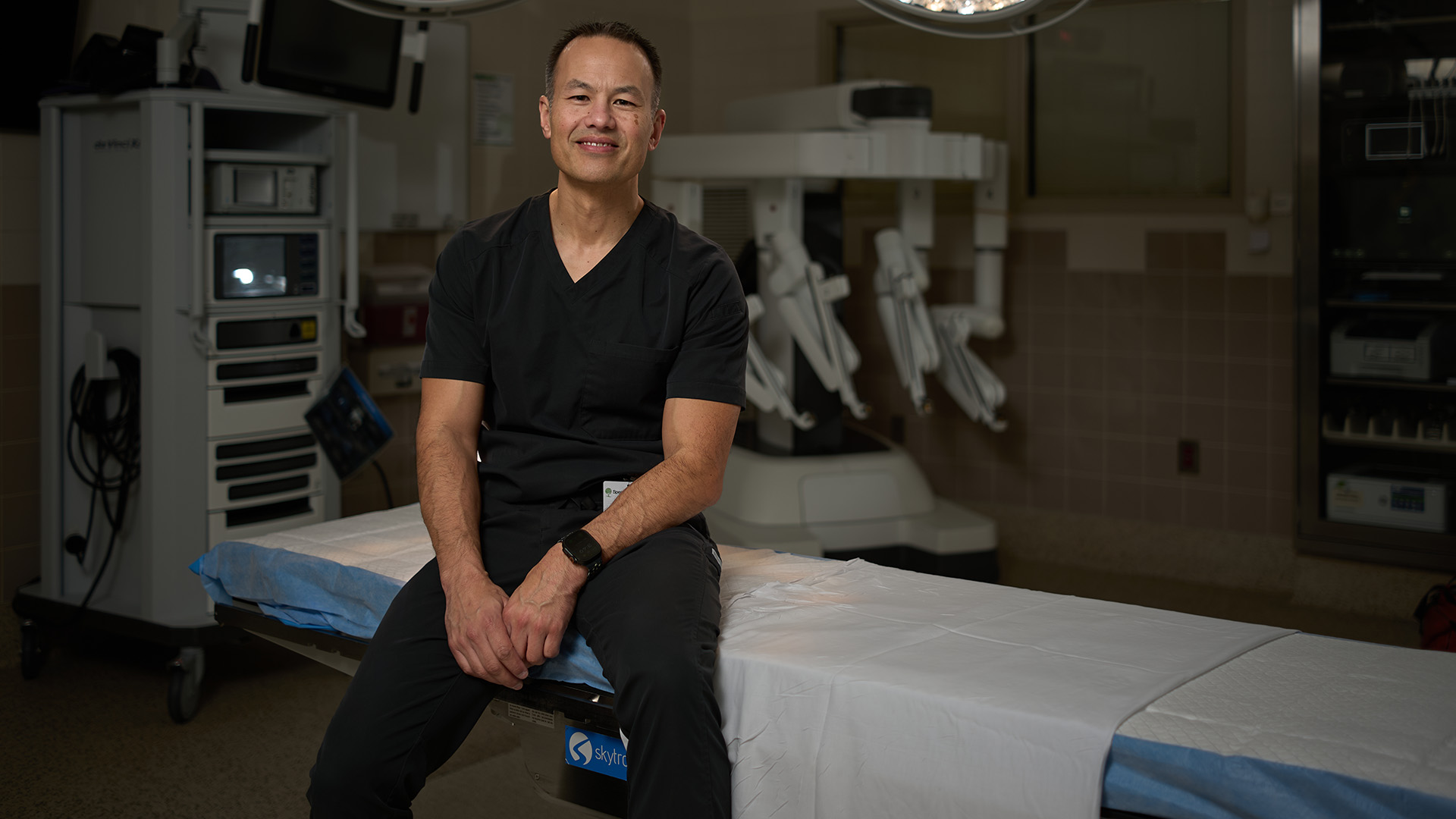
Jason Keonin’s practice group consists of five surgeons covering a broad area in northwest Iowa: Spirit Lake, Spencer, Estherville, Emmetsburg, Pocahontas, and Sibley, as well as the surrounding smaller communities.
Rural robotics
The lack of availability of specialty care, certain diagnostic tests, and other resources can be a challenge for rural physicians. Despite the limitations, Keonin’s practice group strives to offer the best possible care options for their patients. One example: They have offered minimally invasive surgery with robots since 2015.
“We’ve always been kind of ahead of the curve with laparoscopic and minimally invasive surgeries,” he says. “We don’t want to become curmudgeonly surgeons that do things exactly the same way we did 20 years ago.”
With the support of the hospitals they serve, the group invested in new technology and the training they needed to use it expertly.
“It was fun to learn something new. And now we have a flourishing robotic surgery program,” Keonin says. “For certain surgeries, it’s the best way to do it. Because I’m doing fewer incisions, that means less pain and quicker recovery for the patient.”
As Keonin approaches the milestone of his 1,000th robotic case, he is grateful to practice in an environment that is supportive to innovation.
“I feel blessed,” he says.
“I always envisioned raising children in a small town and giving them a similar experience to where I grew up.”
Work-life balance in a rural setting
Keonin’s practice group consists of five surgeons covering a broad area in northwest Iowa: Spirit Lake, Spencer, Estherville, Emmetsburg, Pocahontas, and Sibley, as well as the surrounding smaller communities.
“We have an interesting practice that’s fairly unique,” Keonin says. “When my dad worked, it was him and one other general surgeon. They were on call every other night. In our group, we rotate to a different hospital each week. That keeps it more even for how busy we are in our cases.”
Each surgeon only takes call once a week, and they take turns covering weekends. The model has been remarkably sustainable for work-life balance.
“I rarely miss kids’ events. It’s not uncommon for me to be done in time to pick up the kids,” Keonin says. “We can arrange our schedules and make it work.”
It also provides welcome variety, which helps the surgeons keep their skills fresh. Over time, Keonin has grown to feel like an integral part of each of the communities he serves.
“Every time we go to some of these outlying hospitals — every time we’re able to do surgery for someone close to home, so they don’t have to travel — they are always really appreciative,” he says. “You really start to form connections, and the more you feel connected, the more you want to keep that relationship going.”
He encourages future physicians not to be afraid of the demands of rural practice.
“I love what I do,” he says. “If you want to be a general surgeon, but you also want to dedicate time to family or hobbies or start a business or whatever it is, you can probably find that situation and make of it what you want.”