University of Iowa art students imagined bold, kinetic machines that make art. Engineering students in Berlin are helping transform those wild ideas into real-world designs.
Story: Emily Nelson
Photography: Justin Torner and courtesy of Elizabeth McTernan
Published: May 29, 2026
Hannah Versch pulls back an L-shaped piece of wood. It swings forward, setting off a chain reaction — kicking a sculpture, rattling a rack, and sending tubing flying.
The prototype may be simple, but the idea dreamed up by the third-year University of Iowa art major from Seattle is anything but. She envisions a mechanized leg kicking a “meatball” sculpture, launching spaghetti-like tubes and paint “sauce” onto a surface to create art.
“It’s a bit like Anish Kapoor meets Richard Serra,” remarks Elizabeth McTernan, assistant professor and head of sculpture and intermedia at the University of Iowa School of Art, Art History, and Design.
“And Jackson Pollock,” Versch adds, laughing.
While the piece is just a simple model now, Versch is working with a class of engineering students in Germany to bring her dream closer to reality.
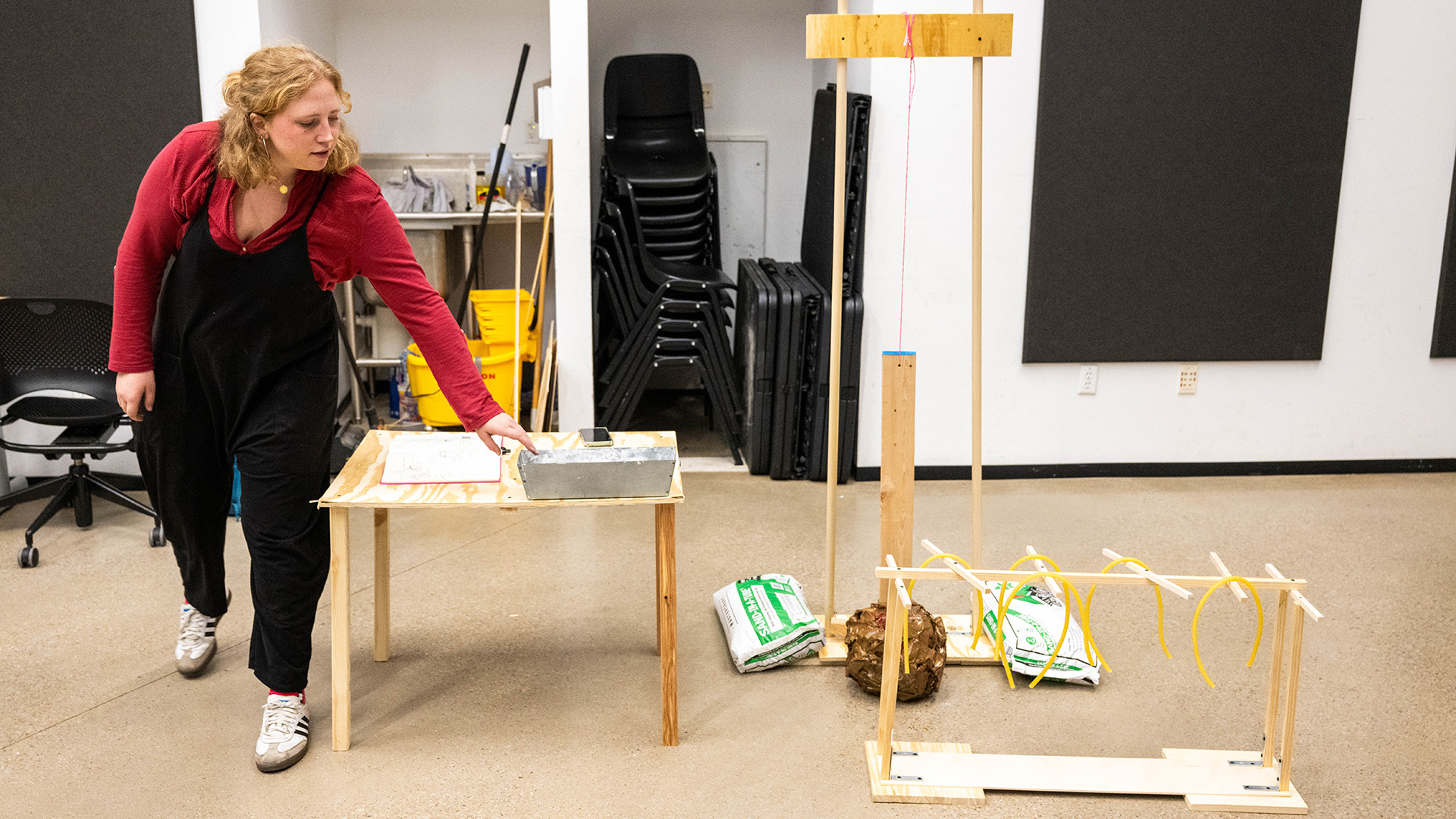
Hannah Versch, a third-year University of Iowa art major from Seattle, envisions a mechanized leg kicking a “meatball” sculpture, launching spaghetti-like tubes and paint “sauce” onto a surface to create art. Engineering students in Berlin will help bring Versch's vision to life.
The project is a collaboration between McTernan and Ina Holfelder, professor of mechanical design and machine elements at Berliner Hochschule für Technik.
During McTernan’s spring 2026 Fantastic Drawing Machines class, art students experimented with designing weird kinetic art objects, ultimately creating drawings and mock-ups for their own “fantastic drawing machines.”
Those designs were then passed on to Holfelder’s engineering students in Berlin, who will use specialized tools such as CAD (computer-aided design) and AR (augmented reality) glasses to create professional digital designs that can be used for fabrication. The Iowa and German students worked together virtually through mid-May, when the University of Iowa semester ended. The German students will finish the designs by the end of their term in mid-July.
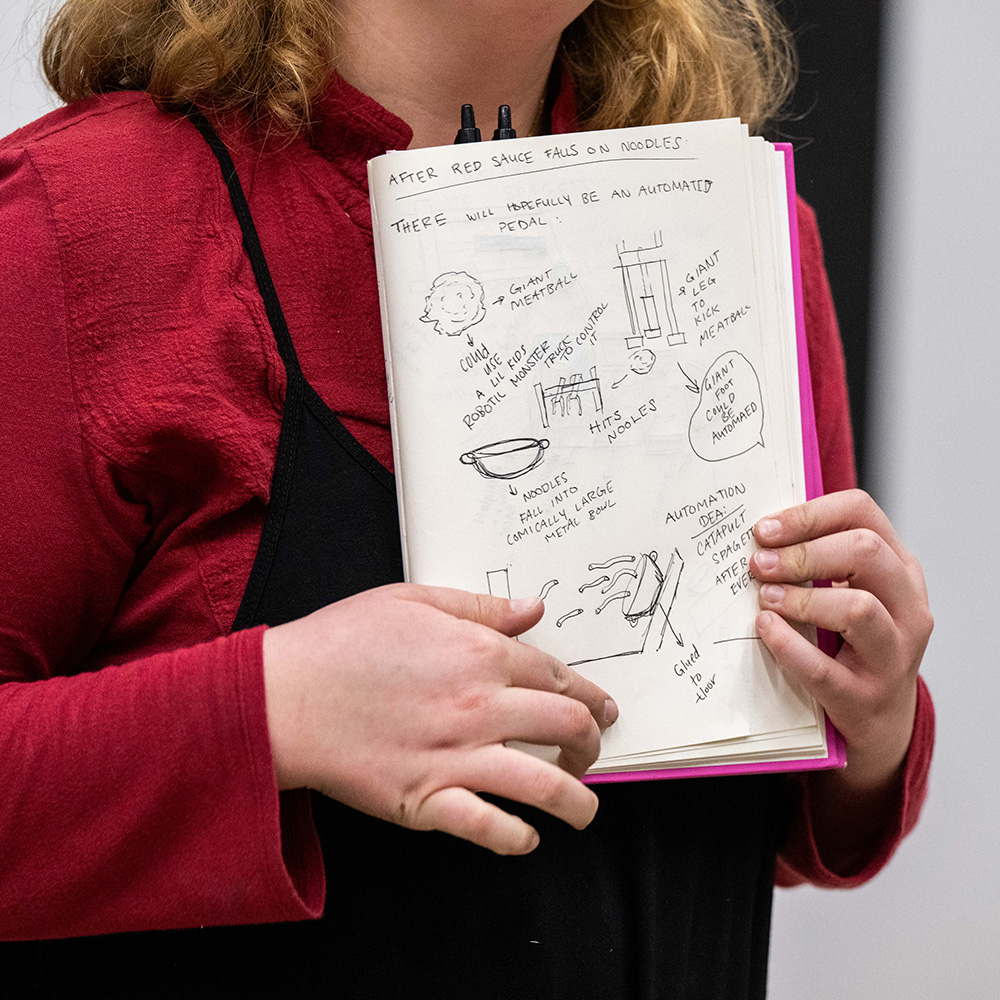
Hannah Versch holds sketches of her art project idea.
The partnership came out of what McTernan calls a “meet cute.” When McTernan moved to Berlin, Holfelder was her neighbor, and the two became fast friends.
“She’s one of these unicorn scientists who’s genuinely interested in the intellectual space of the art sphere,” McTernan says.
Meanwhile, McTernan became engrossed in Holfelder’s scientific work while editing Holfelder’s writing. They stayed in touch and began looking for an opportunity to work together after McTernan moved back to the United States to teach at the University of Iowa.
McTernan says one of the main goals for the course was to give her art students the confidence to reach out to people in other fields to help bring their visions to life.
“I want to show them it’s possible to make ambitious, complex work that exceeds their individual skill sets,” McTernan says.
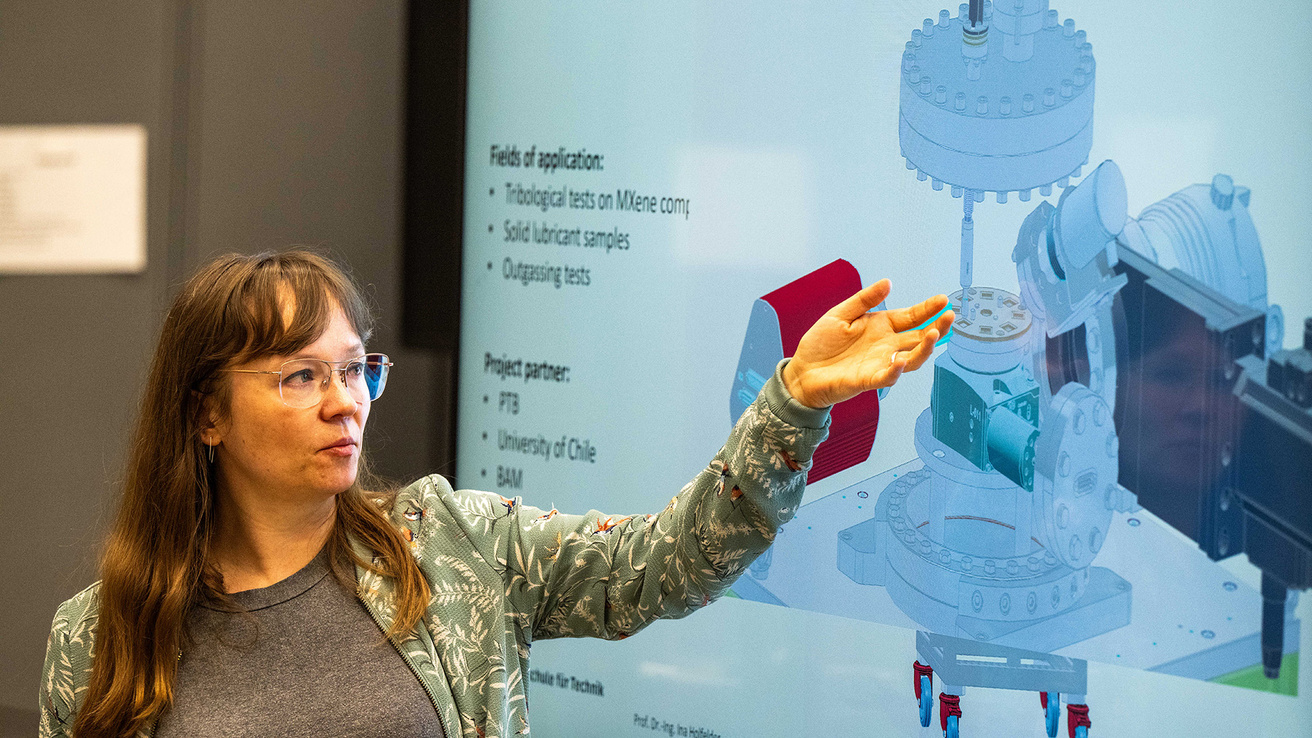
Ina Holfelder gestures while giving a presentation to University of Iowa art students. Holfedler teaches engineering at a university in Berlin; her students will help bring the Iowa art students' visions to life.
For Holfelder, the collaboration is also about improving student outcomes and broadening participation in engineering.
“Studies show students in engineering-art collaboration projects become more creative, motivated, and successful,” Holfelder says.
About one-third of mechanical engineering students in Germany drop out, she adds, and women remain underrepresented in the field.
“I hope to attract more female students and help my students learn to communicate and work across distance and time with a totally different discipline and different culture,” Holfelder says.
For students on both sides, the collaboration quickly became more than just a design exercise.
Versch admits she was initially intimidated meeting the German students, but the feeling faded quickly.
“My group was so fun. We were constantly cracking jokes, and their English proficiency is amazing,” Versch says. “Everyone was respectful and truly asked stimulating questions.”
The conversations have expanded what Versch thought was possible for her design. Her original idea was to use a foot pedal to catapult the spaghetti onto the wall, but the engineering students suggested using a button — an approach they are now pursuing.
“The engineering students are very black-and-white, literal thinkers,” Versch says. “This is a somewhat common theme when speaking to people outside of the art world. It makes me learn how to talk to different people. I’m excited to get new ideas and discover a new way of thinking and learning.”
Ethan Wyatt says he was drawn to the class by both its name and the chance to work with engineers.
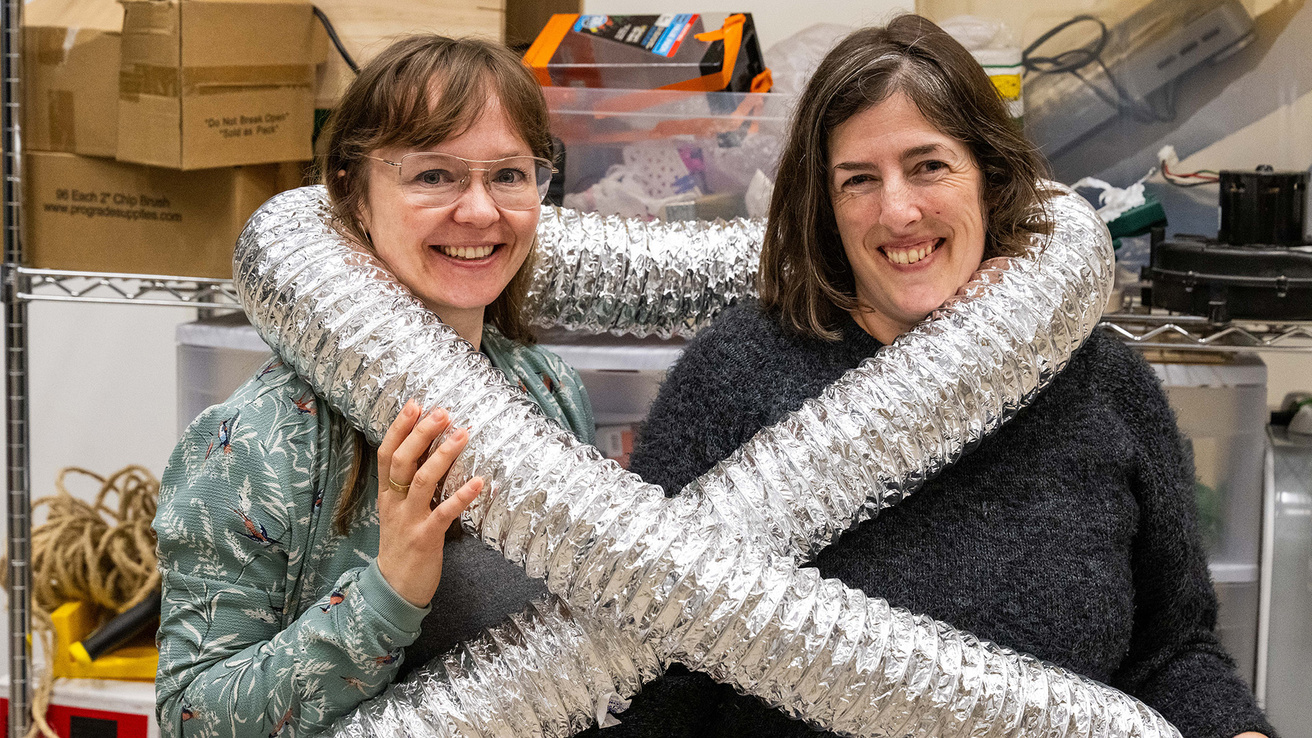
Elizabeth McTernan (right) met Ina Holfelder when McTernan moved to Berlin and became neighbors with Holfelder. They stayed in touch after McTernan moved to Iowa, and found an opportunity to collaborate through McTernan's Fantastic Drawing Machines course.
“It’s fun to mix artists with the more logical minds of engineers,” says Wyatt, a fourth-year art major with a focus in sculpture and intermedia from Glenwood, Iowa. “It’s always fun to see the middle ground and what comes out of it.”
Holfelder traveled to the U.S. in March to meet the Iowa students before her class in Germany began in April. During the visit, the students showed off their designs and demonstrated with simple mock-ups what they hoped Holfelder’s students could ultimately build.
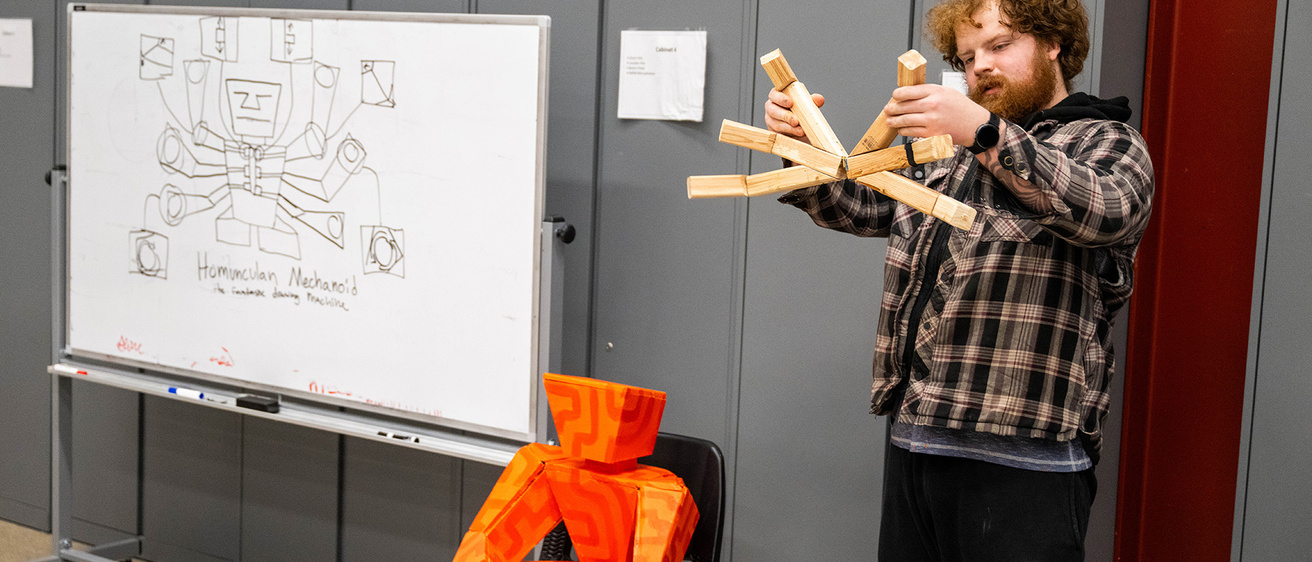
For Wyatt, that meant his “Homunculan Mechanoid.” Wyatt envisions the six arms of his robot moving around to create art. How the arms move, what they sound like, and what they draw with — or on — remained undecided until discussions with his German partners.
The experience has pushed Wyatt beyond his comfort zone.
“There’s more to art than just drawing or just sculpting,” he says. “This has been a good class to explore the other things that are out there.”
Mahsa Fallah says her interest in kinetic sculptures drew her to the class. Her project involves looking through colored fluid in a glass container that then runs through a mass of tubing spanning multiple stories.
“I’m very excited to see how the engineers can pick up where my ideas stop and take them further,” says Fallah, an MFA student in sculpture and intermedia from Tehran, Iran. “I absolutely think this experience will be useful in the future.”
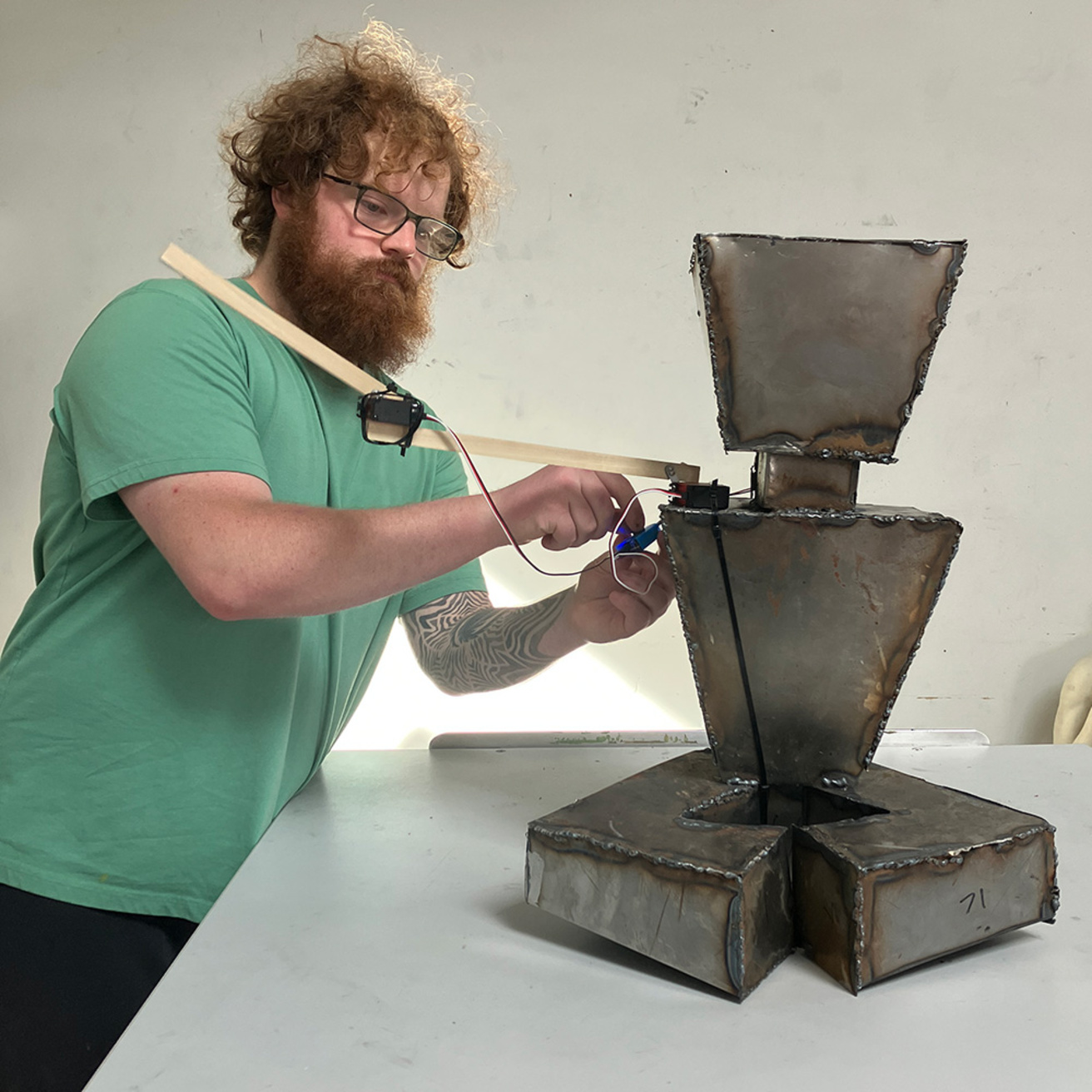
Fantastic Drawing Machines has pushed Ethan Wyatt to take his art further. “There’s more to art than just drawing or just sculpting,” he says. “This has been a good class to explore the other things that are out there.”
McTernan says grant funding is being sought to allow a future Iowa art class to fabricate the fantastic drawing machines based on the German students’ designs, thus fully bringing her students’ concepts to life.
Even if that doesn’t happen, McTernan says the student collaboration was always the main objective. However, her students will be left with a valuable artifact.
“Having someone develop these designs in the real world can be very costly,” McTernan says. “And fortunately, many CAD designs now can be made specifically for materials that our art students can bring to our CNC Prototyping Suite and have the pieces cut on the laser cutter and then assemble themselves.”
Primarily an oil painter, Versch says enrolling in the course — one that reimagines what’s possible when art and engineering collide — was a happy accident.
“This is my favorite class I have ever taken,” Versch says.


