
Cystic fibrosis adds daily treatments to JJ Ward’s routine, but it hasn’t dampened his enthusiasm for sports, school, and fishing. With support from UI Health Care Stead Family Children’s Hospital, the 6-year-old Davenport boy and his family face the future with hope.
Story and videography: UI Health Care Marketing and Communications
Photography: Liz Martin
Published: Oct. 5, 2026
When newborn JJ Ward began coughing up a dark-colored discharge at a local hospital, his care team initially suspected he may have aspirated meconium. But an X-ray revealed a large mass in his abdomen, prompting the hospital to call an emergency transfer team.
“They wanted to fly him, but the weather didn’t allow,” says his mother, Tara.
JJ was instead rushed by ambulance to University of Iowa Health Care Stead Family Children’s Hospital, where his father, Jake, followed shortly behind. Tara, who was still recovering from a C-section, was discharged later that day and joined them in Iowa City.
JJ was diagnosed with meconium ileus, an uncommon intestinal obstruction in newborns that occurs when abnormally thick meconium — a baby’s first stool — blocks the small intestine.
During her pregnancy, Tara had additional ultrasounds, but she and Jake were told there were no major concerns. After JJ was born, they quickly realized something was wrong when he began coughing up what appeared to be green or brown fluid.
“They thought maybe he aspirated some meconium at first,” Tara says.
The No. 1 children's hospital in Iowa
University of Iowa Health Care Stead Family Children’s Hospital is Iowa’s only nationally ranked children’s hospital, offering all pediatric subspecialties and caring for kids from all 99 counties in Iowa. We provide world-class pediatric care that families trust — and kids deserve.
A lifesaving surgery
JJ was born in May 2020, when COVID-19 precautions were in place. Both parents, however, were allowed to be at the hospital for his surgery the next morning.
“Everyone was so comforting there, saying ‘We’ll get this fixed. It will be all right,’” Jake says.
The surgical team removed about a third of JJ’s small intestines. The team also suspected he had cystic fibrosis, as the obstruction can serve as a sign of the hereditary condition.
“His bowel had twisted on itself, and the part that was twisted had necrotized,” Tara says. “It was really a critical thing for them to catch, as not much longer and he could have died from it. We were just so fortunate we had good providers who were able to diagnose that quickly.”
Results from Iowa’s newborn screening tests confirmed JJ had cystic fibrosis, a disease that causes sticky, thick mucus to build up in the body and damage the lungs, pancreas, and other organs. Neither Jake nor Tara knew of other family members with the hereditary condition.
“It was a disease we knew nothing about,” Tara says. “JJ’s care team educated us, showered us with resources, and presented a message of hope, which a Google search did not.”
Surgeons inserted a long-term IV line and temporary feeding tube while JJ healed. Because of visitor restrictions during the early months of the pandemic, his parents had to take turns staying with JJ while he was hospitalized.
“That was one of the most difficult things for us,” Tara says. “We understood, but it took out your only other support system. You’re navigating it by yourself.”
“[Cystic fibrosis] was a disease we knew nothing about. JJ’s care team educated us, showered us with resources, and presented a message of hope, which a Google search did not.”
Additional procedures at Stead Family Children’s Hospital
Because JJ had difficulty gaining weight, surgeons inserted a Broviac line, a central venous catheter used to deliver nutrition and medications directly into the bloodstream.
He was eventually discharged on total parenteral nutrition, or TPN, an intravenous method of delivering liquid nutrients. JJ later was readmitted to the hospital with infections. After he became strong enough, his Broviac line was replaced with a gastrostomy tube, or G-tube.
He has since graduated from the G-tube and has participated in clinical studies to advance cystic fibrosis research.
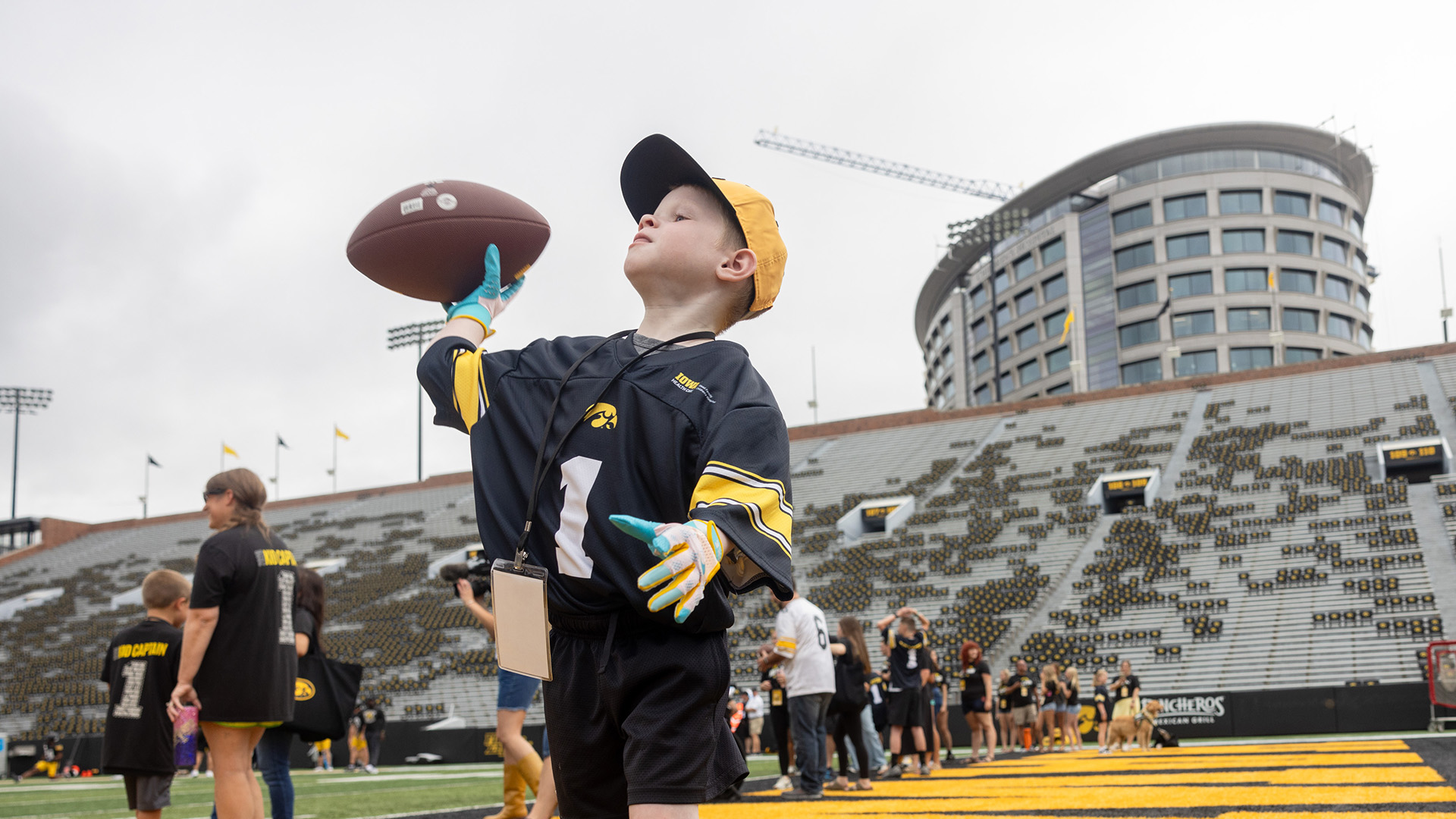
JJ Ward, the Kid Captain for the Iowa Hawkeyes' game vs. the University of Washington, throws a football during Kids Day at Kinnick in August 2026. The Davenport boy enjoys baseball, soccer, wrestling, and other sports — JJ’s care team knows he enjoys playing catch to keep his mind off his procedures.
A global research leader
University of Iowa research has helped transform cystic fibrosis from a disease that was often fatal in childhood into a condition that many people can manage into adulthood.
JJ takes a prescription drug called Trikafta, which fixes the underlying problem in cystic fibrosis. This drug was developed based on innovative research done at the University of Iowa and designed to improve symptoms and slow progression of the disease.
He’s been able to swallow pills since he was 3 years old, Tara notes, and knows what to take in the morning and at night to manage his own condition. JJ also uses nebulizers and undergoes chest physiotherapy to clear his airways.
“He would appear to be a regular 6-year-old on all fronts, but when he’s sick, he is very sick,” Tara says. “His day may look a little different, but he doesn’t let it stop him from doing the things he likes.”
Now 6 and in first grade, the Davenport boy enjoys baseball, soccer, wrestling, and other sports — JJ’s care team knows he enjoys playing catch to keep his mind off his procedures. He loves school, especially art classes, and also likes boating and fishing.
“He’s spunky,” Tara says.
JJ’s health care journey inspired Tara to finish nursing school, and she now works in the surgical specialty unit at the local hospital where JJ was born.
His parents appreciate the quick response time and care JJ has received at Stead Family Children’s Hospital.
“They’re just always available and there’s a whole team of people rooting for JJ,” Tara says. “They become family to you.”
2026 Kid Captains

Meet Kid Captain Eliana Gaul

Meet Kid Captain Lily Lee
