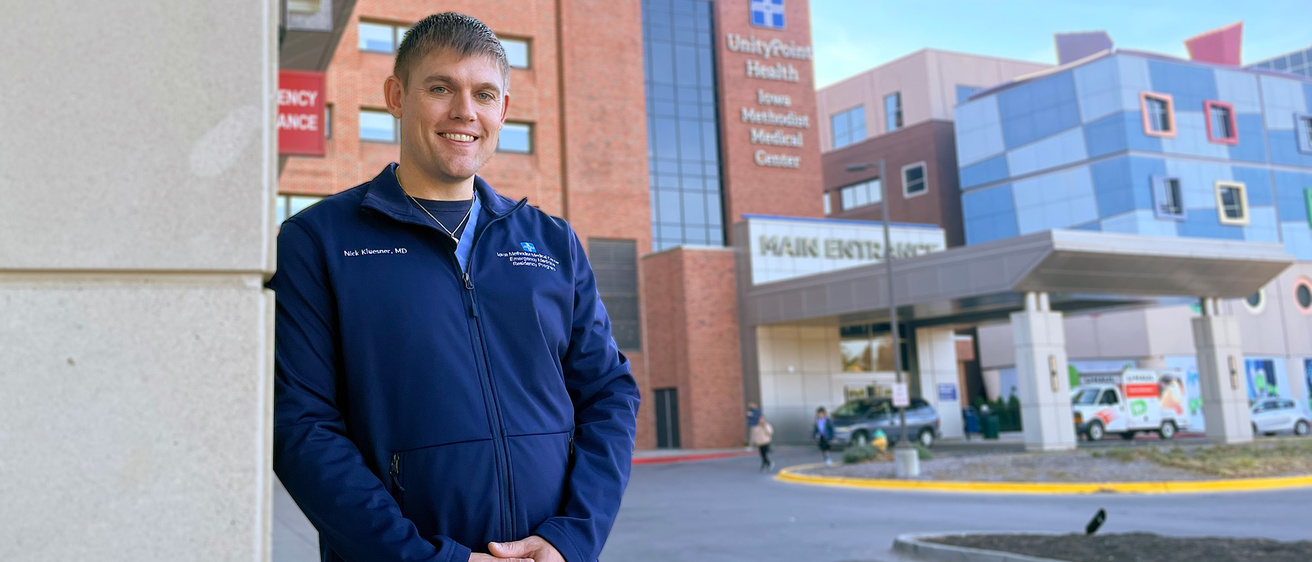
University of Iowa alumnus Nick Kluesner, MD, is using his background in philosophy to make his mark on the future of health care in Iowa.
Story: Celine Robins
Photography: Ryan Potter
Published: Nov. 30, 2023
Last updated: March 25, 2026
Through his required liberal arts coursework at Notre Dame, Nick Kluesner uncovered a love for philosophy and biochemistry. After pivoting from engineering to a double-major in philosophy and biology, Kluesner began to consider where the two disciplines might naturally intersect to create the basis for a fulfilling career.
Spoiler alert: He now has the initials “MD” after his name.
“I had a familiarity with medicine growing up, but I hadn’t really heard about life from the physician side of things,” says Kluesner, who grew up in Ames, Iowa.
Both his parents worked in health care, but neither as a physician, so it was through job shadowing in the local hospital emergency department that Kluesner discovered how medicine combined his interests in science and the humanities. He now holds a Doctor of Medicine from the University of Iowa Carver College of Medicine.
“The mixture of detective work with relationships, problem solving, and working to help people when they’re in crisis really resonated with me,” he says.
When it was time to apply to medical school, Kluesner was confident about returning home to Iowa. After obtaining his medical degree, his experiences with UI Carver College of Medicine faculty and his drive to care for Iowans led Kluesner to stay at Iowa for residency training.
“When I was finishing residency and looking for where to practice, my wife and I came to a clear consensus that Iowa was the best place to raise our family. We’ve been here in Des Moines now for 12 years and have no plans of leaving,” he says.
Emergency ethics
Kluesner’s propensity to dig deep and ask big questions didn’t wane during his medical training.
“I was constantly looking for the practical side. How does this biochemistry course apply to taking care of patients? How do I make decisions that help people based on this abstract chemical formula that we’re memorizing?” he says. “I think asking those bigger questions and pushing myself to be more intentional was my philosophy training manifesting.”
The fast-paced and analytical nature of emergency medicine held a particular appeal for Kluesner. In hindsight, he sees a connection between his inquisitive nature and his choice of specialty, though it wasn’t an obvious motivator at the time.
“We resuscitate sepsis. We pull things out of people. We stitch things back together. It’s all very impactful in real time,” he says. “You would think of philosophy as a pretty abstract background for that, but there’s an arm of philosophy that’s entirely practical: that’s ethics.”
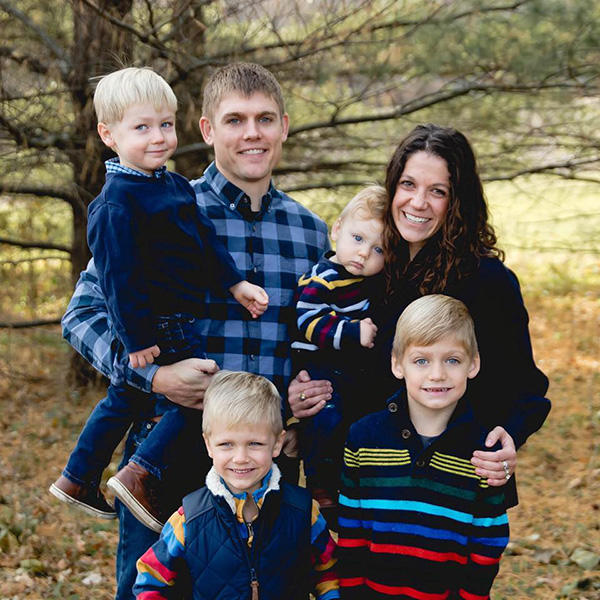
“When I was finishing residency and looking for where to practice, my wife and I came to a clear consensus that Iowa was the best place to raise our family,” says Nick Kluesner, MD, a graduate of the UI Carver College of Medicine. “We’ve been here in Des Moines now for 12 years and have no plans of leaving.”
In both his ethics classes and practicing in the emergency department, Kluesner felt responsible for answering the same basic question: What is the right thing to do in this situation for this person?
“In medicine, we are forced to make very serious decisions that are of immense consequence, sometimes with limited information. Maybe we don’t have all our tests back, or we don’t have the whole story from the patient,” he says. “Imagine having a patient with ‘Do not resuscitate’ tattooed on their chest, with a different advanced directive scribbled on a napkin and a daughter from California on the phone giving you a third imperative. You have to figure it out and make a decision: Is this the right thing to do for the patient?”
In addition to his day-to-day work as an emergency medicine physician in Des Moines, Kluesner also channels his passion for medical ethics as both a member of the American College of Emergency Physicians Ethics Committee on a national level and as chair of the Iowa Medical Society’s Law and Ethics Committee. He travels around Iowa to teach the ethics of errors, informed consent, end-of-life care, and other tough topics to help providers develop their medical decision-making under pressure. Kluesner also writes and reviews policies and position statements on some of the most controversial topics in medicine, to be used at both state and national levels.
“I was constantly looking for the practical side. How does this biochemistry course apply to taking care of patients? How do I make decisions that help people based on this abstract chemical formula that we’re memorizing? I think asking those bigger questions and pushing myself to be more intentional was my philosophy training manifesting.”
One of his favorite “professional pastimes” is writing essays on the interplay of medicine and the humanities, such as his article “The ED in a tradition of refuge,” published in the July 2021 edition of the American Journal of Emergency Medicine.
“It’s part of the ethos of emergency medicine culture to be the point of access for patients who have nowhere else to turn,” he says. “It’s not just for people with medical emergencies, but also social, legal, or mental health problems. They don’t know where to go, so they come to us — the safety net.”
Expanding access to emergency medicine physicians
Kluesner’s career evolved in spring 2024, when the first class of future resident physicians matched to the Emergency Medicine Residency Program at UnityPoint Health–Des Moines. Kluesner serves as associate program director alongside fellow Carver College of Medicine graduate Brian Jennett, MD.
The training program complements the University of Iowa by providing the “bread and butter” emergency medicine experience that’s most often needed in rural areas of the state, Kluesner says.
“I loved my time at the University of Iowa and have great respect and connections with the faculty there,” he says. “In Des Moines, we know we can provide excellent training and recruit even more medical students to pursue emergency medicine, who will hopefully stay in Iowa to practice.”
Kluesner believes the expanded training offerings will have a downstream effect as the number of emergency medicine trained physicians in the state increases over time.
“Most Iowans aren’t aware that the majority of emergency care provided in our state isn’t delivered by providers who are board-certified in emergency medicine. I think we can help change that,” he says. “The emergency department can drive the quality of care, since that’s where it tends to start for most patients in the hospital.”
The first class of six will graduate from the three-year program in June 2027, and the program will welcome its third class this summer.
“The emergency medicine residents we train have gained clinical experiences not just in a Level 1 trauma center but also in the community sites of Iowa Lutheran and Methodist West, at Blank Children’s Hospital, and even a month of rural practice in Grinnell,” Kluesner says. “They experience the full spectrum of emergency medicine in our state, from urban to suburban to specialty to rural.”
Medicine at Iowa
The Roy J. and Lucille A. Carver College of Medicine is a highly ranked medical school where students learn to become accomplished clinicians and top-flight researchers and educators. Students come to Iowa to study medicine in a program that uses case-based learning as the basis of their education.