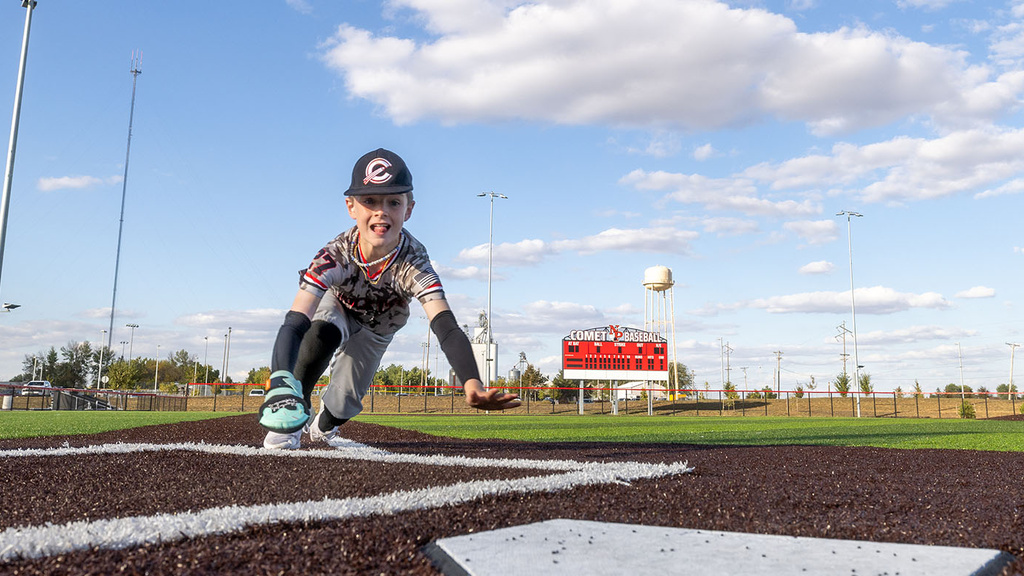
After standard treatments failed to improve her son's cerebral palsy symptoms, Rachel Conrad found hope at Iowa's only pediatric spasticity clinic — and now 5-year-old Sawyer is thriving.
Story: Jordan Ludwig
Photography: Liz Martin
Published: April 7, 2026
When Rachel Conrad of Indianola first noticed delays in her son Sawyer’s development, she wasn’t sure whether to be concerned. Born prematurely at 29 weeks at University of Iowa Health Care, he spent time in the NICU and was expected to need extra time to reach early milestones.
As the months passed, though, Conrad grew increasingly worried that there was something more going on.
“Getting a diagnosis was the hardest part,” Conrad says. “We kept asking ourselves whether he was missing milestones because he was premature or because something else was going on.”
By his first birthday, Sawyer still couldn’t sit up, talk, or crawl. Providers at UI Health Care Stead Family Children’s Hospital began investigating, and over the next year and a half he underwent therapies, imaging, specialist visits, and genetic testing.
When he was 2 years old, Sawyer was diagnosed with right hemiplegic spastic cerebral palsy, which causes stiff muscles and weakness or paralysis on one side of the body.
A life-changing next step
Following the diagnosis, Sawyer began intensive physical, occupational, and speech therapy at his local physical therapy facility. Around that time, the family also began working with pediatric physiatrist Kathleen Vonderhaar, MD, at Stead Family Children’s Hospital’s Center for Disabilities and Development.
Vonderhaar guided the Conrads through several standard treatment options, including Botox injections, a muscle relaxant called baclofen, and serial casting, which uses repeated casting of the legs to help stretch his muscles and improve movement. But none of these approaches led to meaningful improvement, leaving the family unsure about next steps.
“Every morning Sawyer would wake up with soreness, and as he grew, he was slowing down even more,” Conrad says. “I couldn’t imagine this being the rest of his life.”
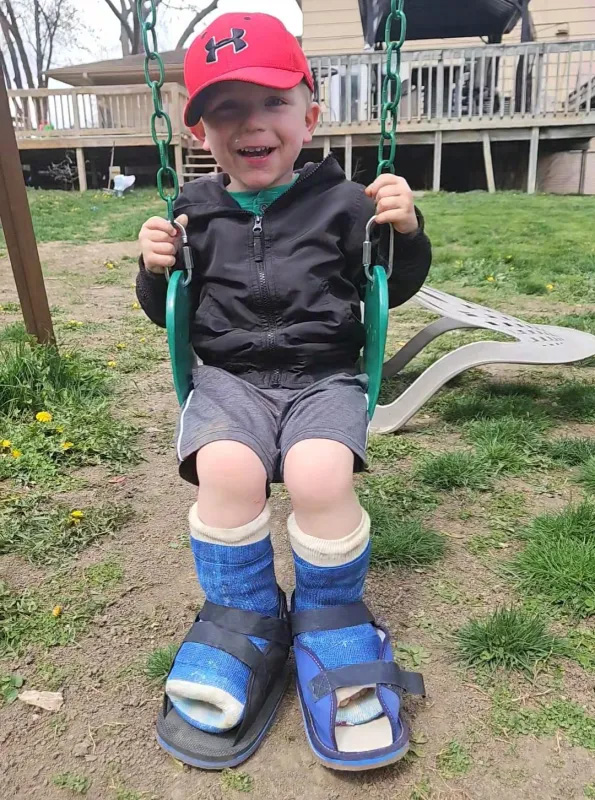
Sawyer spending time in his yard while wearing casts and boots during treatment.
One of Sawyer’s therapists had previously mentioned selective dorsal rhizotomy (SDR) — a surgery that reduces spasticity by cutting specific nerve fibers in the lower spinal cord. As Sawyer’s treatment options became limited, the Conrads revisited the idea.
“We started having bigger conversations about SDR,” Conrad says. “That’s when Dr. Vonderhaar told us it was a good time to transition to the spasticity clinic at Stead Family Children’s Hospital.”

Collaborating across specialties, UI Health Care experts work together to provide comprehensive, coordinated, spasticity care and guide treatment decisions.
Iowa’s only pediatric spasticity clinic
Stead Family Children’s Hospital’s spasticity clinic is the only pediatric clinic of its kind in Iowa, bringing together specialists from neurosurgery, physiatry, orthopedic surgery, and physical therapy to treat children with spasticity, a condition that causes muscles to stay tight and rigid, making walking and other movements difficult and potentially leading to joint deformity. It is also one of the few clinics in the nation to offer SDR.
“Our spasticity clinic brings specialists from different areas together in one place, so families receive the most comprehensive care possible,” says pediatric neurosurgeon Rebecca Reynolds, MD. “We want parents to feel informed and confident. Seeing the entire team in a single visit gives families the opportunity to ask questions and make decisions together about what’s best for their child.”
At the spasticity clinic, the Conrads were able to meet with Reynolds, Vonderhaar, and orthopedic surgeon Heather Kowalski, MD, at nearly every appointment. Having the care team together made a meaningful difference as they explored treatment options, including SDR. Each specialist brought a unique perspective, creating a collaborative, team‑based approach that helped guide the Conrads’ decision‑making.
“Bones, joints, and nerves are incredibly interconnected, especially in growing children,” Kowalski says. “When one system isn’t functioning well, it affects everything else — how a child moves, how they grow, and how their body adapts over time. Most clinics don’t have all of these specialties in one place, but here, we make decisions as a team to help each child get a treatment plan that supports their whole body, not just one part of it.”
This type of coordinated care made a meaningful difference for the Conrads as they explored treatment options, including SDR.
“Nearly every time we went to the spasticity clinic, we were able to see all three members of his care team at once,” Conrad says. “You don’t have to play catch-up because everyone is in the same room. You’re not left waiting for one person to decide if something is the right step. They’d talk it through right in front of me, and I loved that.”
On March 20, 2025, at age 4, Sawyer underwent SDR surgery.

From crossing his legs for the first time to running and playing with greater stability, Sawyer continues to reach meaningful milestones.
On the recovery track
Conrad describes Sawyer’s recovery after SDR as a roller coaster — full of ups and downs, but ultimately a ride worth taking.
“We see progress all the time in little ways,” she says. “In fact, he was progressing so quickly and was so ready to get moving that we actually had to slow him down.”
Since surgery, Sawyer has fallen far less — a significant shift for a child who was often covered in bruises — and he became fully potty trained for the first time.
“Usually at the zoo, Sawyer would be falling constantly, but after SDR, he didn’t fall once,” Conrad says. “I think that was the moment I realized SDR was one of the best decisions of our lives.”
Although he still attends the same therapies as before, the family hopes to gradually scale back as he gains independence. In the meantime, they celebrate small victories that once seemed impossible.
“Sawyer had never been able to cross his legs,” Conrad says. “Four days after surgery, he said, ‘Hey mom, look,’ and he was sitting in his car seat with his legs crossed. It’s such a normal thing, but it was huge for us.”
Redefining what’s possible
Today, Sawyer is a confident, active 5‑year‑old who can run, jump, and was even cleared to join wrestling this year — something Conrad once thought would be impossible for him.
“Wrestling made him realize that everything he works on in therapy helps him in other ways,” she says. “He’d struggle with a skill in practice, they’d work on it in therapy, and at the next practice he’d say, ‘I’ve been working on this.’ He is so proud.”
Conrad is grateful for the care team at the spasticity clinic and hopes their family’s experience can help others navigate similar challenges.
“We’re very grateful we did it,” Conrad says. “It doesn’t change the diagnosis, but the improvement in his quality of life has been more than we ever imagined. Every parent wants their child to have a good quality of life. SDR and the spasticity clinic gave us that.”