When a child is diagnosed with cancer, the journey belongs to the whole family. For one Iowa family, University of Iowa students participating in Dance Marathon turned fear into connection and community.
Story: Sara Epstein Moninger
Photography: Tim Schoon and courtesy of Liz Pearson
Videography: Clarity Guerra
Published: Feb. 10, 2026
When Liz Pearson looks back on the earliest days of her 11-year old daughter Penelope’s cancer treatment, one detail stands out: University of Iowa students volunteering with Dance Marathon.
“They were the first people who didn’t need anything from us,” says Pearson, whose family lives in North Liberty, Iowa.
Penelope was diagnosed with high-risk B-cell acute lymphoblastic leukemia in December 2022, just days before Christmas. The family was newly immersed in hospital rooms, medical language, and uncertainty. Doctors came in with questions. Nurses came in with medications. Everyone needed something.
Then the students showed up.
“They didn’t ask Penelope to do anything,” Pearson says. “They just wanted to know if she wanted to hang out and have fun or go pick out presents.”
Those students were part of University of Iowa Dance Marathon, a student-led organization that raises money for pediatric cancer care and spends thousands of hours each year volunteering on Level 11 of UI Health Care Stead Family Children’s Hospital. For the Pearsons, Dance Marathon became something far bigger than a fundraiser.
“It felt like they showed up just to be there,” Pearson says.
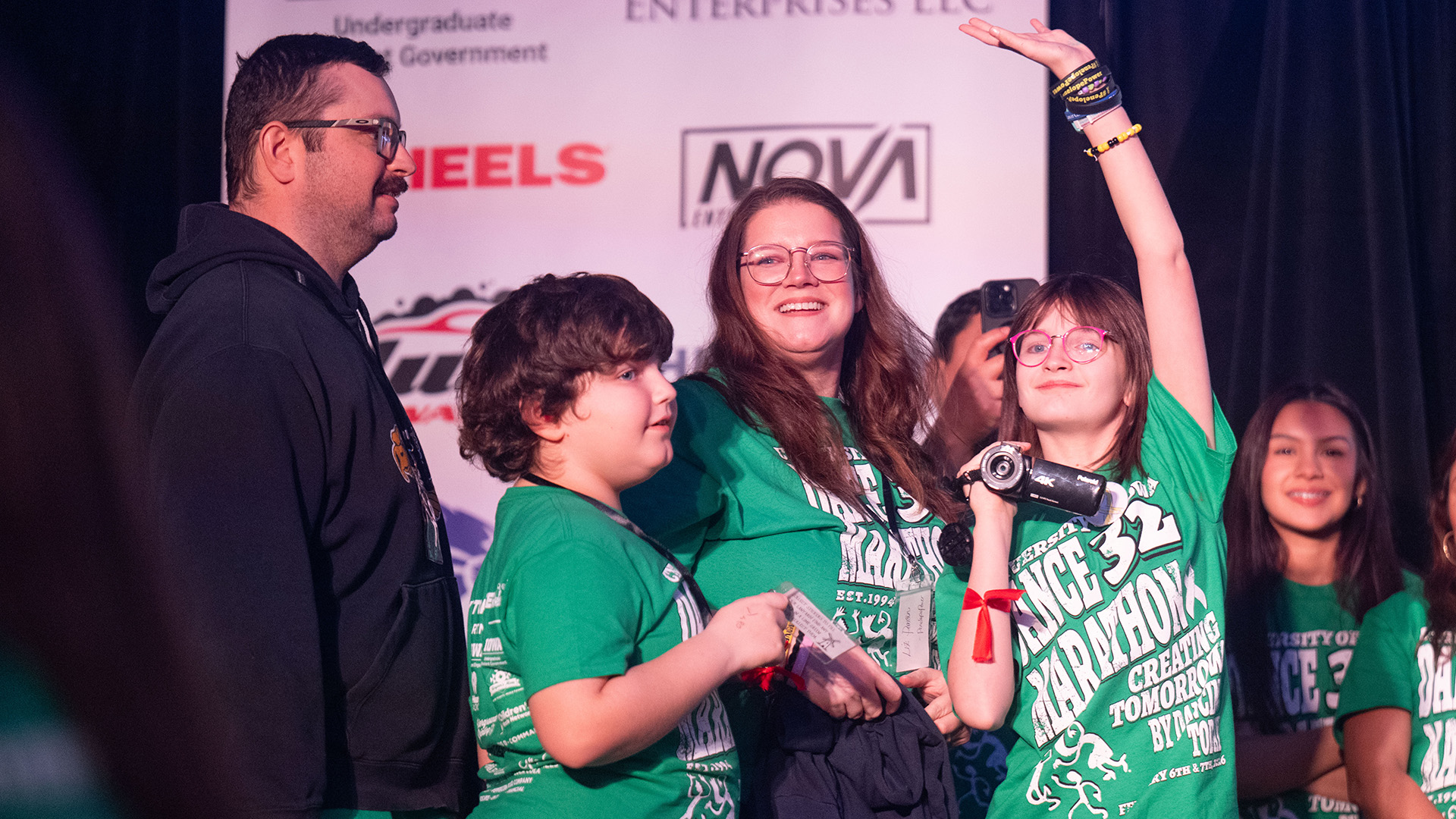
Penelope Pearson (hand raised), who was diagnosed with cancer in 2022 and has been in remission since 2025, participates in UI Dance Marathon’s Big Event at the Iowa Memorial Union with her parents and brother. Not only were they part of the annual event's opening ceremony, they also shared their family’s story on the main stage.
Care that surrounds a family
Penelope was 9 years old when she began treatment. Her younger brother, Theo, suddenly found himself navigating hospital visits, long waits, and a new version of family life where attention centered on medical urgency.
But Dance Marathon volunteers knew Theo by name.
“They always made sure there were things for him too,” Pearson says. “They would ask, ‘What does Theo like?’ And months later, we’d get a care package with Legos for him.”
It mattered more than the family expected.
“Theo doesn’t remember a time before cancer,” Pearson says. “So having people acknowledge him — and ask about him — made such a huge difference.”
That focus on the whole family is intentional. Dance Marathon volunteers are trained to support not just patients but siblings and parents as well. Many of the students have personal connections to pediatric cancer themselves, either as patients or siblings.
“They know how to make kids feel like kids,” Pearson says, “while still understanding how hard it all is.”
More than a hospital visit
During Penelope’s inpatient stays, Dance Marathon volunteers came into her room to play games, do crafts, and simply spend time with her. When in-person volunteering paused during the pandemic, students adapted, hosting weekly trivia nights and craft sessions over Zoom that families could join from their hospital rooms.

Did you know?
Since it began in 1994, University of Iowa Dance Marathon has raised more than $39 million to support youth cancer patients and their families at UI Health Care Stead Family Children’s Hospital, where the 11th floor is named the UI Dance Marathon Pediatric Cancer and Blood Disorders Center. Student participants not only raise money for the kids (or “FTK,” as they say) and volunteer in the hospital, they also develop career skills and personal connections that last a lifetime.
“Sometimes Penelope was the only kid who felt up to joining,” Pearson says. “It would be five or six volunteers and one 9-year-old girl, just hanging out like they were best friends.”
That sense of connection extended far beyond the hospital.
The Pearsons have participated in Dance Marathon’s Big Event at the Iowa Memorial Union, UI Homecoming parades, community events, and family outings. Penelope served as a “mile motivator” for Dance Marathon runners during the Chicago Marathon, recording a video message and choosing a song to encourage participants. She’s modeled Dance Marathon merchandise and walked the runway at a Halloween fashion show alongside Theo.
“She got to hold a sign that says ‘Six months out of treatment,’” Pearson says of one parade moment. “Everyone was cheering for her. It was very cool.”
One year, Penelope couldn’t attend the Big Event because a severe chemotherapy complication landed her in the pediatric intensive care unit, so the family streamed the event to her hospital room.
“She watched Dance Marathon from the PICU,” Pearson says. “It was still special.”

“Cancer treatment is so isolating. It’s so lonely. But we never really felt the full effect of that because Dance Marathon wouldn’t let us.”
A place for hope — and science
While Dance Marathon helped fill the emotional gaps, the Pearsons’ medical care was provided by pediatric oncology teams at Stead Family Children’s Hospital.
Penelope’s treatment included participation in a clinical trial for an immunotherapy drug called blinatumomab, also known as Blincyto. The trial proved so successful that it ended early and the drug became standard treatment for children with Penelope’s diagnosis.
“It didn’t feel like chemo,” Pearson says. “She felt normal, for the most part.”
Penelope carried a small backpack with a pump delivering the medication continuously for 28 days. Aside from mild flu-like symptoms at the beginning, the therapy allowed her to maintain a sense of everyday life during treatment.
“It really did wonders for her,” Pearson says. “We’re so grateful she could be part of that study.”
Clinical trials like Penelope’s are a cornerstone of pediatric cancer care at UI Health Care, giving families access to cutting-edge treatments. For families facing long treatment timelines — two and a half to three years for many leukemia patients — those advances can be life-changing.
Penelope finished active treatment in March 2025 and remains in remission. She continues regular follow-up visits and labs, part of survivorship care that will continue for years.
“When she reaches five years post-treatment,” Pearson says, “we’ll have a big celebration.”
Penelope already has plans: “Then I can have a car,” she says, grinning.

“We didn’t realize how much Dance Marathon would take care of us,” says Liz Pearson (center, right), whose daughter, Penelope (center, left) was treated for cancer at UI Health Care Stead Family Children’s Hospital. To give back, the family takes any opportunity they can to support the student organization, including participating in the annual Call for Kids with Cancer Radiothon.
A community that stays
For the Pearsons, the relationship with Dance Marathon didn’t end when treatment did.
They still see volunteers — some of whom have graduated — at Camp Heart Connection, a free weeklong summer camp in Boone, Iowa, for children affected by cancer and their siblings. Many Dance Marathon students volunteer there too.
“We’ll walk up to the cabins and see Dance Marathon volunteers and say, ‘Oh, you’re here too,’” Pearson says.
The students stay in touch. They send photos from camp. They check in. They show up to milestone celebrations.
“It feels like an extended family,” Pearson says. “Like a bunch of cool cousins and aunts and uncles.”
That consistency matters, especially after the intensity of treatment ends and families are left adjusting to a new normal.
“Cancer treatment is so isolating,” Pearson says. “It’s so lonely. But we never really felt the full effect of that because Dance Marathon wouldn’t let us.”
Students who carry the mission forward
Behind the scenes, students like UI senior Amelia Earley help make that support possible.
Earley serves as Dance Marathon’s family liaison director, coordinating family events and acting as a bridge between students and families. Her motivation is personal: In 2014, her younger brother, Mason, was diagnosed with a brain tumor. He has undergone more than a dozen chemotherapy treatments and continues to live with the disease.
“As a sibling, it’s kind of awkward,” Earley says. “People don’t always think to check in with you.”
That experience shaped her approach to leadership within the organization. Earley’s committee ensures that sibling-focused activities are built into family events and the Big Event, recognizing that cancer affects entire families, not just patients.
“It’s a small thing,” Earley says, “but it makes a big difference.”
For students, Dance Marathon also offers something less visible but equally lasting: an education in empathy. Earley, a human physiology major on the pre-med track, plans to pursue pediatric oncology. Volunteering on Level 11 — interacting with families and shadowing physicians — has shown her the kind of provider she wants to be.
“Seeing how much it matters when a doctor remembers a sibling’s name — that sticks with you,” she says.
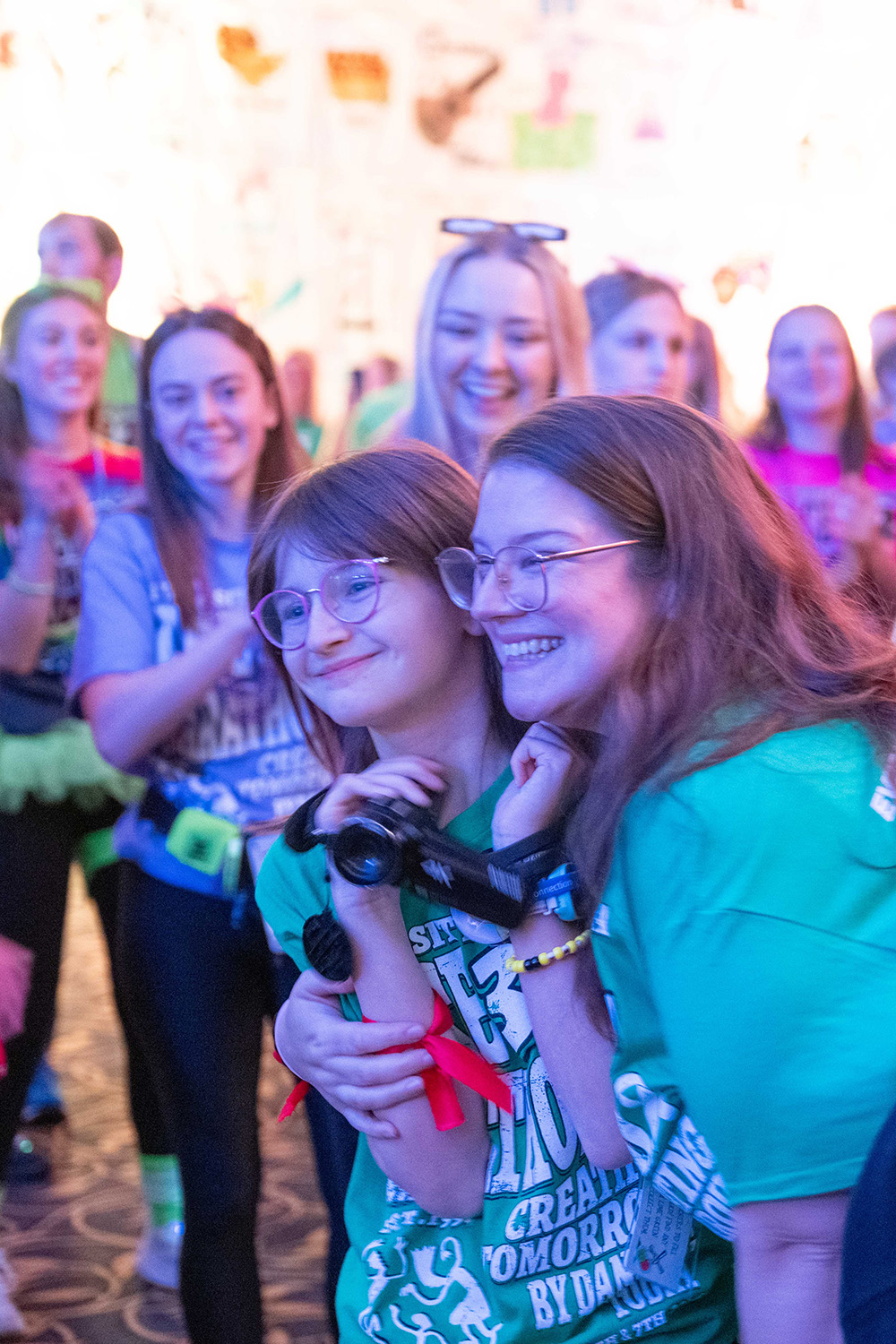
Penelope Pearson finished active treatment in March 2025 and remains in remission. Penelope's mom, Liz, praises the students of UI Dance Marathon for their kindness: “Every time we look around and something good is happening, Dance Marathon is usually involved.”
More than a student organization
Since it began in 1994, UI Dance Marathon has raised more than $39 million to support pediatric cancer patients and their families at Stead Family Children’s Hospital. Nearly 1,500 families are connected to the organization, and in 2026 alone, more than 1,300 students are participating.
But those numbers tell only part of the story.
The rest is found in hand-embroidered hoodies gifted at the end of treatment. In mouse ears provided for a Disney World trip. In a child laughing during trivia night. In a sibling opening a care package made just for them.
“Every time we look around and something good is happening,” Pearson says, “Dance Marathon is usually involved.”
For the Pearsons — and families across Iowa and beyond — Dance Marathon is more than a student organization. Coupled with the providers at UI Health Care, the volunteers form a network of care that blends science, compassion, and community.
“They wouldn’t let us be lonely,” Pearson says.
And for families facing their hardest moments, that can make all the difference.