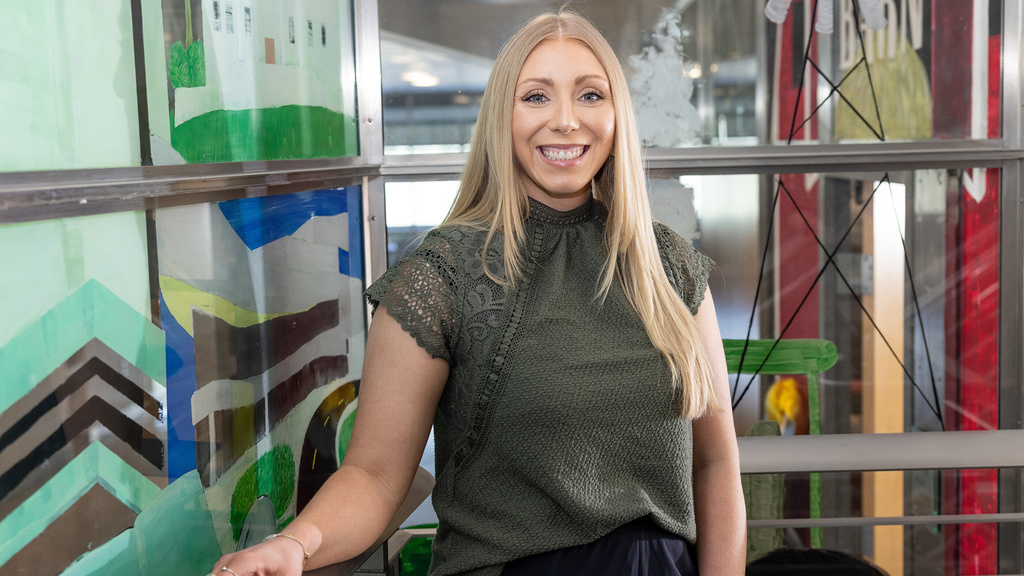
Experiencing her father’s death in a farming accident and the pressures of COVID-19 as a health care worker inspired Bailey VandeLune to pursue emergency medicine. Now, she’s committed to making a difference in a rural community like the one she grew up in — Winterset, Iowa.
Story: Celine Robins
Photography: Liz Martin
Published: May 4, 2026
Growing up on a crop farm outside Winterset, Iowa, Bailey VandeLune learned early what it meant to be a responsible member of a community. Years later, those same values would guide her toward a career in medicine, shaped by both personal loss and a deep understanding of the challenges rural communities face in accessing care.
As she prepares to graduate with her medical degree from the University of Iowa Carver College of Medicine this spring, VandeLune remains committed to serving communities like the one that raised her.
Tell me about where you grew up. How did it affect your path to medicine?
I grew up on a crop farm just outside Winterset, Iowa. Growing up on a farm with my older brother, parents, and many pets taught me a great deal about responsibility, empathy, and community long before I knew I wanted to pursue medicine. One of the aspects I cherished most about growing up in Winterset was the close-knit nature of the community — everyone knew and supported one another.
At the same time, growing up in a rural area gave me early insight into the health care disparities that frequently affect communities like my own. In high school, I tore my ACL playing soccer, and the local hospital had only one orthopedic surgeon who held a clinic one day each month. I had to carefully plan my schedule around that single day, and if no appointment was available, my only option was to miss school and travel 45 minutes to Des Moines.
This experience helped me recognize that many people in rural communities face similar challenges with access to care and may not have the flexibility or resources to travel to a larger city. My experiences growing up in Winterset strengthened my understanding of the urgent need for accessible health care in rural Iowa.
How did you first decide that you wanted to become a doctor?
My path to medicine began in high school. I had an excellent AP biology and anatomy and physiology teacher, Annette Purdy, who inspired my curiosity about human physiology, health, and disease. This led me to study human physiology at the University of Iowa.
As an undergraduate student, I began working as a nursing assistant at the hospital, and I quickly realized how much I enjoyed spending time with patients. At the same time, I developed a growing curiosity to better understand the science behind the medical conditions I encountered. Watching physicians engage with patients, their families, and the health care team highlighted the blend of knowledge, critical thinking, teamwork, and compassion involved in patient care. Those interactions ultimately inspired me to pursue medicine.

Bailey VandeLune advises future physicians to cultivate their humanistic qualities while they go through their medical training. “You might get an additional point or two on an exam if you spend a couple extra hours studying, but it may not always be worth sacrificing meaningful moments in your life such as a family member’s birthday party, a celebration of a friend, or the opportunity to be present for someone you care about.”
You worked as a nursing assistant during COVID. What stands out to you from that time?
When COVID-19 arrived in Iowa, the unit where I worked as a nursing assistant became the designated COVID unit. Wearing masks, face shields, gowns, and gloves, we navigated an environment filled with uncertainty, fear, and many critically ill patients. With visitor restrictions in place, many patients were isolated from their families.
I witnessed firsthand how the health care team stepped up to provide comfort, support, conversation, and human connection in addition to excellent care. I learned a great deal about humanity in medicine. This experience highlighted not only the critical role each team member plays, but also the remarkable way health care professionals come together to support one another and provide the best possible care.
Your father had an accident just before you started medical school. How did that shape your perspective?
Before starting medical school, I lost my father in my hometown emergency department following an accident on our farm. For the first time, I experienced health care from the perspective of a patient’s family member rather than as part of the care team.
Through this experience, I developed a deep appreciation for the compassion and empathy required to care not only for critically ill patients, but also for the families who are often by their side. My father’s death continues to shape my approach to patients and their families during moments of uncertainty, vulnerability, and loss. It motivates me to become a compassionate, empathetic, and resilient emergency medicine physician.
Why did you decide on emergency medicine?
Several factors have drawn me to emergency medicine and reinforced that it is the specialty where I can contribute most meaningfully. During my rotations in the emergency department, I felt comfortable and calm in the chaos.
My experience as a nursing assistant working in a COVID unit during the pandemic — as well as working as a server in college — taught me to think quickly, anticipate needs, and perform under pressure. I also believe my background in athletics has been influential; emergency medicine requires strong teamwork among nurses, students, technicians, physicians, and other staff.
Additionally, I value the emergency department’s role as a safety net for the community. At any hour, emergency departments care for patients of all ages, backgrounds, and circumstances, ensuring access to care when it is needed most.
Tell me why you decided to be part of the Carver Rural Iowa Scholars Program (CRISP).
Growing up in rural Iowa played a significant role in shaping my desire to learn more about rural medicine, with the goal of one day returning to a community like the one where I was raised.
In recent years, emergency departments across the state have seen an increase in patients presenting with needs that could be addressed in a primary care setting. Many of these visits stem from a shortage of physicians and primary care providers in rural communities. My experiences growing up in a rural area, along with my clinical rotations in rural hospitals, have strengthened my commitment to advocating for patients in these communities and improving access to care across Iowa.
What advice would you give to a new medical student?
Throughout medical school, it is important to remember that while developing a strong foundation of medical knowledge is essential, cultivating your humanistic qualities is equally important. You might gain an extra point or two on an exam by studying a few additional hours, but it may not always be worth sacrificing meaningful moments — such as a family member’s birthday, celebrating a friend, or being present for someone you care about.