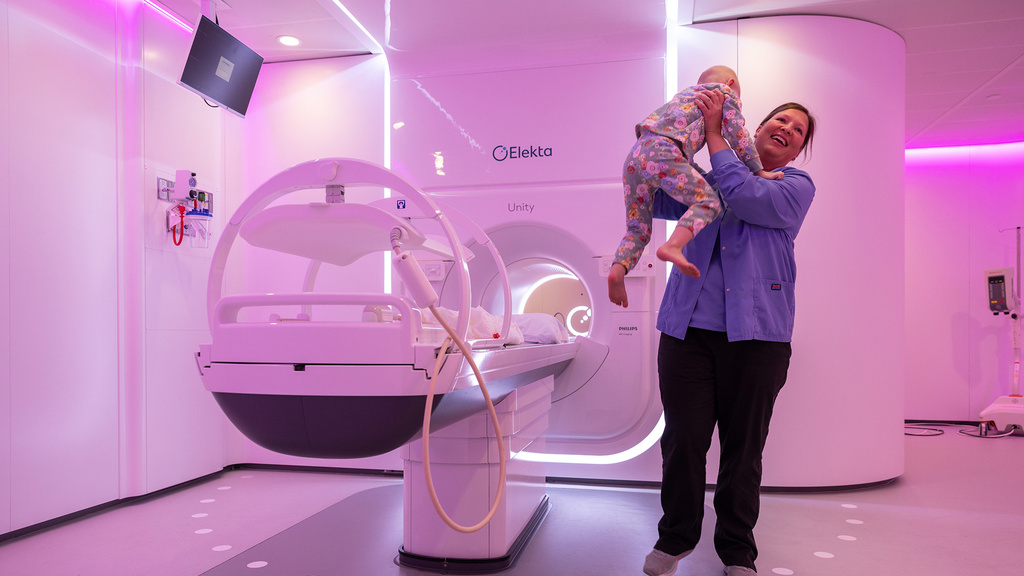
When Ron Muhlenbruck was diagnosed with a rare cancer in 2005, he came to the University of Iowa — then a rising leader in neuroendocrine tumor research. Twenty years later, Iowa remains the only U.S. institution to receive specialized federal funding twice for this rare cancer.
Story: Jen A. Miller
Photography: Liz Martin
Published: May 18, 2026
In 2005, Ron Muhlenbruck of Osage, Iowa, went to the doctor with an odd, recurring problem: His face would become flushed as if he were experiencing a hot flash. He was prescribed metformin, a common diabetes medication, but over time he started seeing blood in his stools.
His doctor ran a specialized urine test that revealed Muhlenbruck had neuroendocrine tumors (NETs) — cancers that form in cells that act like both nerve cells and hormone-producing cells.
NETs are typically slow-growing tumors that most often occur in the small bowel, pancreas, and lungs. Because they grow slowly, they often go undiagnosed for years. And that same slow growth means they don't respond well to traditional chemotherapy, which targets fast-growing cancers.
While NETs aren't as common as other cancers, diagnoses have increased more than fivefold since 1975.
Muhlenbruck was referred to University of Iowa Health Care and its Holden Comprehensive Cancer Center, one of the country's leading centers in NET research and treatment for the past 25 years.
Iowa’s leadership in neuroendocrine tumor research
In fall 2025, researchers with Holden were awarded a five-year, $10.7 million grant from the National Cancer Institute to study new, targeted therapies for NETs. It's the second such award for Iowa — making it the only institution in the country to receive this level of specialized federal funding for NET research.
The program builds on decades of groundbreaking work that began in the early 2000s when physician-scientists M. Sue O'Dorisio, MD, PhD, and Thomas O'Dorisio, MD, came to Iowa and grew the NET program into a national leader.
They formed a multidisciplinary team of experts and established the Iowa Neuroendocrine Tumor Clinic, which brought together specialists in surgery, nuclear medicine, medical oncology, and other fields. The team led clinical trials of new treatments that weren't available anywhere else in the U.S.
The NET clinic “attracted people from all over,” says UI endocrinologist Joseph Dillon, MD, professor of internal medicine and director of the clinic. “There were only half a dozen places in the country that, at the time, had real expertise on this type of cancer.”
This work helped bring a treatment called peptide receptor radionuclide therapy (PRRT) to the U.S. PRRT works by delivering radiation directly to tumor cells, killing them and slowing tumor growth.
Muhlenbruck was a participant in the clinical trials that helped establish the treatment's safety in the U.S.
“My finish date in March 2018 was the same day the Food and Drug Administration approved PRRT to the rest of the United States,” he says. “That was the highlight of being in the clinical trial.”

Diagnosed with a neuroendocrine tumor in 2005, Ron Muhlenbruck was a participant in clinical trials at Iowa that established the safety of peptide receptor radionuclide therapy, which was approved in the U.S. by the Food and Drug Administration in 2018.
New research, new hope
The current five-year grant, running through 2030, is led by Dawn Quelle, PhD, professor of neuroscience and pharmacology, James Howe, MD, professor of surgery–surgical oncology and endocrine surgery, and Yusuf Menda, MD, professor of radiology–nuclear medicine. It involves more than 20 faculty members at Iowa working to translate laboratory discoveries into real treatments for patients.
The research includes three main projects:
Improving immunotherapy for pancreatic NETs: Finding ways to make these tumors more responsive to immune-boosting treatments.
Developing new targeted radiation therapy for lung NETs: Combining drugs with specialized radiation treatment that specifically targets tumor cells.
Studying whether common diabetes drugs affect NET growth: Investigating whether popular weight-loss and diabetes medications might impact certain neuroendocrine tumors.
The grant also supports a tissue bank, clinical trial coordination, and training programs for the next generation of NET researchers.
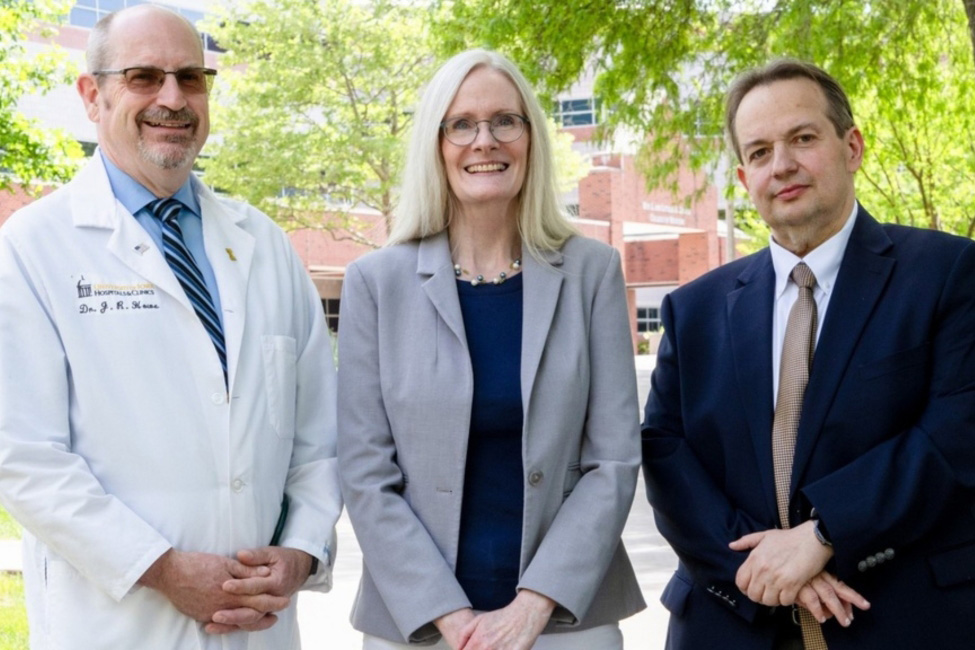
The current SPORE grant — led by co-principal investigators (from left) James Howe, Dawn Quelle, and Yusuf Menda — will involve more than 20 faculty members at Iowa with the goal of translating basic and clinical research into new treatments for neuroendocrine tumors.
A center of excellence
When Muhlenbruck was diagnosed with NETs in his small intestine and liver in 2005, there was no question where he would go for care.
Today, the Iowa Neuroendocrine Tumor Clinic is one of the largest in the U.S., seeing more than 800 individual patients per year. More than 2,500 people nationwide have joined the patient registry at Iowa.
“The NET SPORE provides us a nexus for collaborative basic and clinical science, enabling us to translate our findings into new treatments and give the best, most informed care to these patients,” Quelle says.
From 2005 to 2018, Muhlenbruck’s treatment included radiation, surgery, and PRRT — which together reduced the size of his tumors and slowed their growth. He later served as a patient advocate for the research program, offering input at international meetings as someone who benefited from Iowa's research advances.
Now 79 years old, Muhlenbruck says any side effects from his treatment have been “minor.” He was able to work until retirement and stay active.
Despite having a rare cancer for many years, “it was not a major thing in my day-to-day life,” Muhlenbruck says. “I've felt pretty good during the 20 years I've had this.”
A legacy continues
Today, patients from across the country are referred to UI Health Care based on decades of research that the O’Dorisios and colleagues established. Sue O’Dorisio died in 2025, following Tom O’Dorisio’s death in 2022.
“Tom and Sue O’Dorisio shared a unique commitment to finding better ways to treat patients with this rare type of cancer,” Quelle says. “They built something special here at Iowa that our team is carrying forward.”
Support this research
Your financial backing will help the NET team carry out this important work.