Michael Welsh could not have imagined the life-altering treatments for cystic fibrosis that would grow from the discoveries made in his University of Iowa lab. Once considered a fatal childhood disease, CF now can be managed with drugs that significantly extend patients’ lives.
Story: Sara Epstein Moninger
Photography: Liz Martin and courtesy of Stacy Van Gorp
Videography: University of Iowa Health Care
Published: March 3, 2026
It was a blustery March morning in 2005 when Stacy Van Gorp paused outside the college classroom in Cedar Falls, Iowa, where she was about to teach. The twins she was carrying — usually active and insistent — had gone quiet. Her pregnancy had been unremarkable, so normal that her obstetrician had recently told her she’d likely make it to 36 weeks, maybe even 40.
But something felt off. She called her local doctor’s office, and a nurse urged her to skip class and come in. Hours later, after reviewing ultrasounds, a University of Iowa–trained OB delivered a startling directive: “You need to go to Iowa, and you need to go right now.”
Van Gorp and her husband, Chris Denison, didn’t hesitate. They drove straight to Iowa City, where experts at University of Iowa Health Care identified the cause of the distress: meconium ileus, a dangerous bowel obstruction almost exclusively associated with cystic fibrosis.
Cystic fibrosis (CF) is a rare genetic disease that causes thick, sticky mucus to build up in the lungs, pancreas, and other organs. The disease gradually worsens, and at the time there was no treatment for the underlying cause, only the symptoms.
Earlier in the pregnancy, Van Gorp had tested positive as a CF carrier, but Denison’s test came back negative. Only later did they learn that labs then screened for a limited set of mutations — missing the one Denison carried.
With the babies in crises, there was no time to waste. Maren and Berne were delivered by emergency C-section on March 8, nearly two months early. Two full NICU teams waited in the room. Berne was blue and silent. A pediatric surgeon was called in from home and operated on their son within hours. Maren, also sick, required surgery days later.
The twins would spend nearly two months in Iowa’s NICU — 63 days for Maren, 58 for Berne — battling infections, breathing trouble, and failing IVs. On Easter, Maren stopped breathing and was revived by a nurse practitioner who happened to be standing beside her crib.
“It just felt like they couldn’t catch a break,” says Van Gorp, who was living at the nearby Ronald McDonald House, clinging to each sign of progress. “One would be better, and then the other one would get worse. It was just overwhelming.”
Getting the green light to go home was a milestone, but the challenges continued. Cystic fibrosis shaped every hour, as treatments filled the twins’ mornings and evenings: chest physical therapy, inhaled medication, pills before every feeding, and vigilant monitoring.
“It was constant,” Van Gorp says. “There was never a moment when you could sit and relax.”
Cystic fibrosis: What to know
Cystic fibrosis (CF) is a rare genetic condition that causes thick, sticky mucus to build up in the lungs and other organs, leading to chronic infections and malnutrition.
Some 40,000 children and adults in the U.S. live with CF, with about 1,000 new cases diagnosed each year. For decades, patients with CF rarely lived through their teens.
Although there is no cure for CF, therapies introduced this century — thanks to research conducted at the University of Iowa — target the underlying cause, dramatically improving outcomes. Now, the median survival age for those born in 2020 or later is predicted to be 65.
University of Iowa Health Care is the only accredited CF center in Iowa that offers comprehensive care to both pediatric and adult patients with CF. Patients also have access to cutting-edge treatments through clinical trials.
The disease prevents the pancreas from releasing enzymes to digest food, causing malnutrition, while also clogging airways with thick mucus that easily leads to infections and lung damage. Treatments available at the time could slow CF’s progression, but the prognosis was grim: The twins would be lucky to reach their 30s.
What the couple didn’t know was that discoveries had already unfolded in a UI research lab — close to the NICU where Maren and Berne struggled to survive — that would fundamentally reshape that outlook. Michael Welsh, a physician-scientist trained and employed at Iowa, had led an investigation into CF. His work would lay the foundation for therapies that today give babies born with CF a life expectancy near 65, with many projected to live into their 70s and 80s.

Early patient sets mission into motion
The first CF patient Welsh saw is burned into his memory. As a junior medical student at Iowa in the 1970s, he recalls hearing the young girl’s cough before entering the clinic room. Once inside, he smelled bacteria in her sputum and observed the tremendous effort it took for her to breathe and talk. He was shocked to learn she wouldn’t live beyond her teens.
“That made a big impression on me,” says Welsh, now a professor of internal medicine and director of the UI Pappajohn Biomedical Institute. “We worked as hard as we could to help people with CF, but we couldn’t stop the progression of the disease because we were dealing with the consequences, rather than the fundamental problem. So, understanding the basic defect became my goal.”
In 1989, when scientists supported by the National Institutes of Health, the Cystic Fibrosis Foundation, and the Canadian Institutes of Health Research identified the defective gene that causes the disease — the cystic fibrosis transmembrane conductance regulator (CFTR) — Welsh began investigating how its mutations disrupt the movement of salt and water in and out of cells. His team showed that when the CFTR protein malfunctions or is missing, mucus throughout the body becomes thick and sticky, clogging organs. They also found that the protein could be corrected if kept at a low temperature.
Welsh then helped classify the thousands of CFTR mutations into groups based on how the protein fails, creating a blueprint for medications tailored to specific defects. His team also created the first animal models that closely mimic the disease in humans, enabling researchers to learn how CF disrupts the function of the lung and other organs and to test therapies in ways never before possible.
This scientific roadmap guided industry partners, including Vertex Pharmaceuticals, in creating CFTR modulator drugs that repair or enhance the faulty protein. For many patients, these treatments dramatically improve lung function, reduce hospitalizations, halt disease progression, and double life expectancy.
Welsh was astonished.
“I always had high hopes, but I would never have dared to hope for what we have today. I thought that if we understood CF well enough, maybe we could stop or slow the progression so people wouldn’t destroy their lungs as quickly. I never guessed they’d get better,” he says. “Seeing young people with CF run cross-country or plan their futures — marriage, children, careers — still amazes me. Years ago, people couldn’t plan their lives. Now they can. It’s unfathomable.”

Curiosity and compassion fuel Iowa researcher’s work
From rural beginnings to groundbreaking advances in the treatment of cystic fibrosis, Michael Welsh has helped reshape what’s possible for patients. Supported by a collaborative academic environment at the University of Iowa, his dedication to discovery and improving lives has increased our understanding of this complex condition.
These advances have rightfully shined the spotlight on Welsh, drawing accolades from world leaders in biomedical research. In 2025, Welsh received the Lasker-DeBakey Clinical Medical Research Award and was one of five individuals recognized with a Canada Gairdner International Award — honors that often precede a Nobel.

Maren and Berne Denison, born with cystic fibrosis in 2005, now pursue the sports and studies that once seemed uncertain.
Science turns fear into possibility
For the Denison twins, who turn 21 in 2026, Michael Welsh’s work has been life-changing. Maren, who was eligible to participate in a clinical trial of the medication Trikafta in 2018, remembers near-immediate improvement.
Before the trial, Maren says her lung function was around 65%, and she had just spent four weeks in the hospital with a resistant infection. “I’d wake myself up in the middle of the night coughing. All day long, I’d be coughing, so much so that I couldn’t breathe sometimes,” she says. “After taking Trikafta, I suddenly knew what it felt like to take a full breath.”
Within weeks, Maren’s lung function skyrocketed to nearly 100%. She began maintaining her weight, reduced her daily pill count, and — as a cross-country runner in high school — shaved five minutes off her 5K time.
Berne, whose lungs weren’t hit as hard by CF as his sister’s, wasn’t eligible to take Trikafta until it was approved by the Food and Drug Administration in 2019. But his health also improved. Within six months, he was able to maintain lung function without daily chest physical therapy or nebulizers, which deliver medication in the form of a mist inhaled into the lungs.
“My health is the best it’s ever been,” says Berne, who had spent 10% of his life hospitalized by the time he was 3. “CF used to be the first thing I thought about when I woke up in the morning. Now it’s not.”
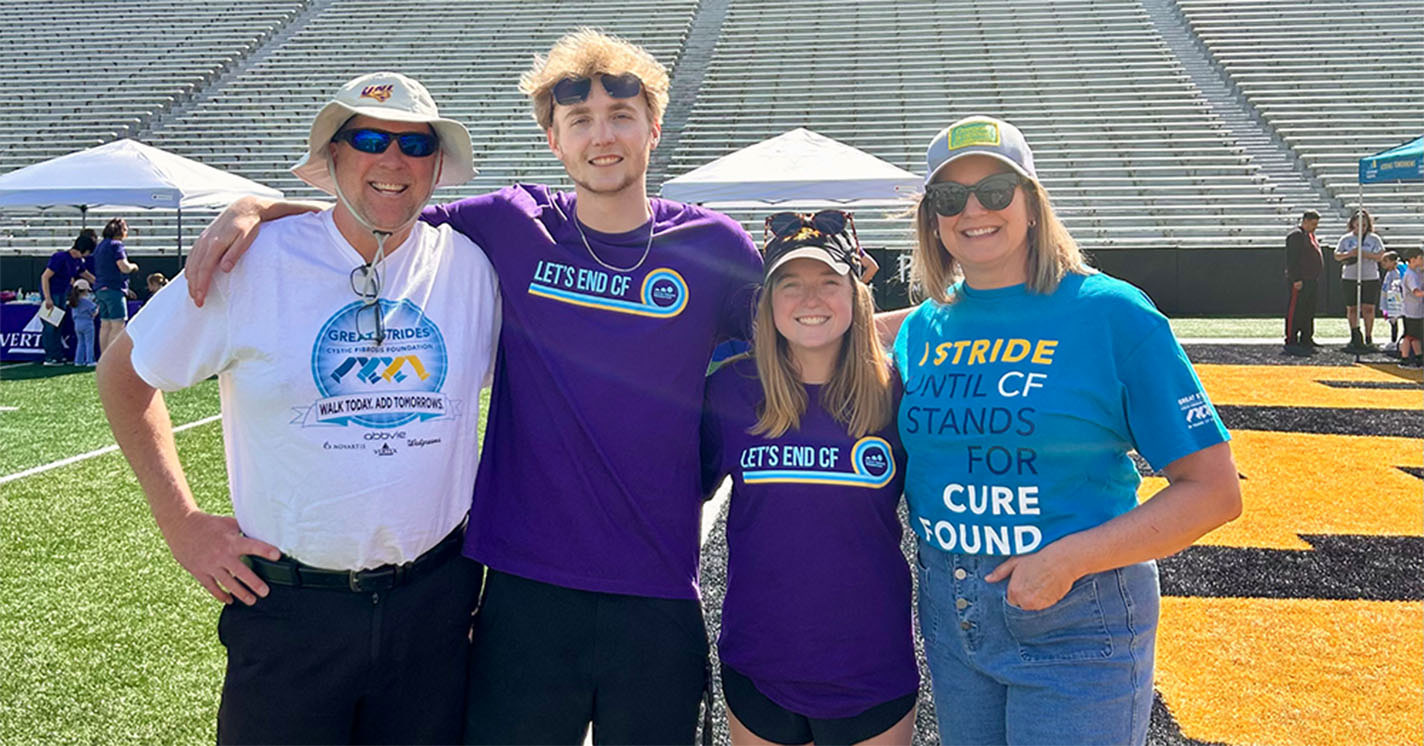
Berne and Maren Denison (in purple) stand with their parents, Chris Denison and Stacy Van Gorp, during the annual Eastern Iowa Great Strides walk at Kinnick Stadium that raises funds for cystic fibrosis research, treatment, and care.
Clinics adapt to changing disease
The introduction of CFTR modulator drugs has dramatically transformed clinical care — at Iowa and across the country. Douglas Hornick, a pulmonologist at UI Health Care, used to manage multiple adult inpatients with CF at any one time. Now, he says, there might be one. Or none.
“With these new therapies, the disease is not progressing as rapidly — or at all,” says Hornick, who joined Iowa’s clinical faculty in 1988.
Hornick says that about 90% of CF patients developed a respiratory condition called bronchiectasis. “I now see more patients with non-CF bronchiectasis than I do with CF bronchiectasis,” he says, “and we’ve been able to apply what we’ve learned treating CF patients.”
About 1,000 new cases of CF are diagnosed annually in the U.S. At UI Health Care, babies born with CF are seen monthly by a comprehensive team including pediatric pulmonologists, nurses, respiratory therapists, dietitians, gastroenterologists, and pharmacists. After the first year, appointments are every three months. As children get older, they also see a pediatric endocrinologist and an ophthalmologist, given their elevated risk for diabetes and cataracts.
Ultimately, patients at Iowa can seamlessly transition to the adult CF clinic. Because new therapies have drastically increased the life expectancy for patients with CF, there are more adults living with CF today than there are children with it.
Early in his career, Anthony Fischer, who earned an MD/PhD from Iowa in 2009, regularly saw pediatric patients with CF whose health deteriorated until they needed a lung transplant or did not survive. Now, his patients on Trikafta stabilize and can go years without hospitalization.
“It’s a totally different disease now,” says Fischer, division director of pediatric pulmonary medicine at Iowa. “The people I worry about the most are the babies who are not yet eligible for Trikafta and the folks who have genotypes that are not eligible. For them, we need better treatments.”
Iowa navigates the next frontier in CF medicine
Even with staggering progress, the work is not done. CFTR modulators have been a lifeline, but about 10% of patients have mutations for which the drugs don’t work, and some cannot tolerate the side effects.
Ashley Cooney, who completed bachelor’s and doctoral degrees at Iowa and now is a research assistant professor of pediatrics–pulmonology medicine, is working to change that by advancing gene therapy. Her postdoctoral research focused on improving gene transfer to airway stem cells and led to a discovery with major implications: mixing a viral vector with hypertonic saline, or salt water, dramatically improved its ability to reach the lungs.
“It’s been a game changer,” she says, noting that because people with CF already inhale hypertonic saline, the formulation has a strong safety track record and could accelerate translation to clinical use. “Now we need to get it to people.”
Seeing the momentum of gene therapy over the past decade, Cooney is optimistic that more advances will come, and she says Iowa is well positioned to be a major contributor.
“Not only is the CF research group here all on one floor, making collaboration much faster, but with the clinic nearby, physician and scientist collaboration could accelerate bench-to-bedside therapies at a faster pace,” she says. “Also, the group is dynamic, supportive, and willing to take risks and challenge the dogma. They demand high performance in the lab — and people thrive in that environment.”
Welsh is at once unifying and inspiring, Cooney says.
“He asks the pressing questions that make you slow down and think about the mechanisms and the biology of what’s happening,” she says. “The way that he leads lab meetings sets people up to push their projects to the next level and not accept the first answer — to dig deeper.”
“If we hadn’t gone to Iowa City that night in March 2005, both of our kids probably would have passed that night. But when we arrived, we had a whole team working together to care for the twins. That teamwork really built our confidence when we needed it the most.”
For the twins, the future is rewritten
When the Denison twins were little, Stacy Van Gorp remembers being unsure what the future held for her children. Would they be healthy enough to attend college? Would such an investment even make sense?
Not only did the quality care they received at UI Health Care save her children’s lives, but the research that took place in Welsh’s lab has allowed the family the joy of planning. Maren is now studying public health and public policy at the University of Iowa and will graduate in May 2026, a year early; Berne is majoring in urban planning at Iowa State University.
“It’s almost indescribable how unexpected their quality of life is,” says Van Gorp, who earned a PhD from Iowa in 2012. “This isn’t a cure, but it is transformational. It’s got to be one of the top science stories of the last 100 years.”
Chris Denison adds, “If we hadn’t gone to Iowa City that night in March 2005, both of our kids probably would have passed that night. But when we arrived, we had a whole team working together to care for the twins. That teamwork really built our confidence when we needed it the most.”
Echoing her husband, Van Gorp says, “We had a sense that Iowa was an important place for CF research, but I don’t think we understood just how important it was. We feel lucky that the University of Iowa is in our backyard.”