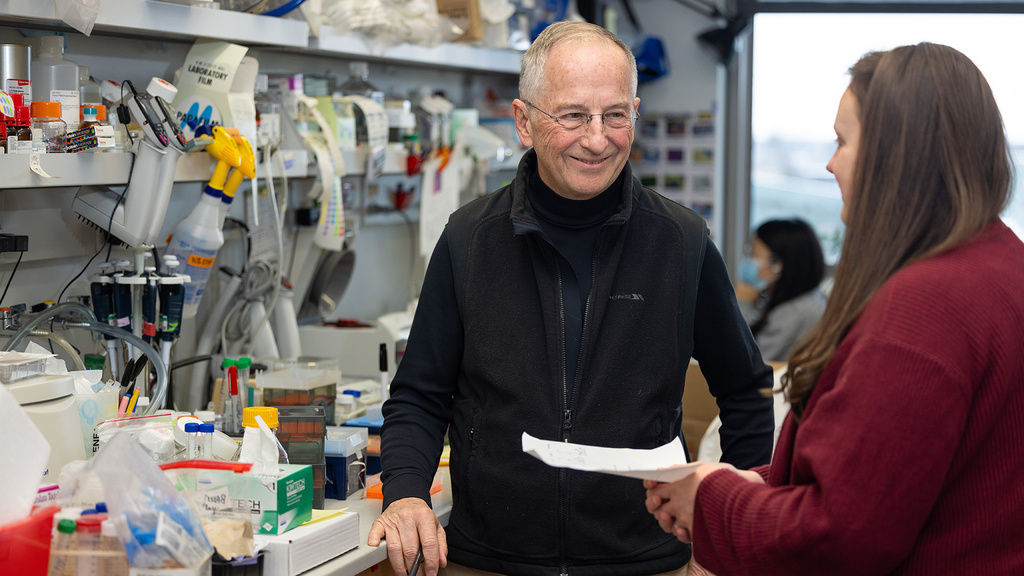
From rural beginnings to groundbreaking advances in the treatment of cystic fibrosis, Michael Welsh has helped reshape what’s possible for patients. Supported by a collaborative academic environment at the University of Iowa, his dedication to discovery and improving lives has increased our understanding of this complex condition.
Story: Sara Epstein Moninger
Photography: Liz Martin
Published: March 3, 2026
Long before Michael Welsh helped unravel the biology of cystic fibrosis (CF) and pave the way for life-changing therapies, he was a kid in rural Iowa who painted barns, raised runt pigs, and learned the value of hard work.
Years later, as a physician-scientist at the University of Iowa, that same determination would fuel his obsession with a scientific mystery — how a tiny defect in a salt channel could devastate a human lung — and lead him to discoveries that have changed the narrative for thousands of people with CF.
Welsh, who received the Lasker-DeBakey Clinical Medical Research Award and a Canada Gairdner International Award in 2025, sat down recently to reflect on the advances in CF treatment instigated by work in his lab. The 1974 Carver College of Medicine graduate and longtime UI professor of internal medicine was quick to credit his Iowa upbringing, the people who challenged him, the patients who trusted him, and the Iowans who have supported research.
What initially drew you to medicine and to scientific research?
I grew up in the rolling hills outside Marshalltown, near the small town of Haverhill. Our school had two classrooms, each with four grades. My class had five students. My parents instilled a strong work ethic in me. My father left school in 10th grade, joined the Marines, fought in World War II, came home wounded, and worked two jobs — a foundry during the day, a bakery at night. My mother raised four kids, kept a large garden, canned vegetables and fruit, and made many of our clothes. Calling someone a hard worker was high praise. I painted barns, made hay, sodded lawns, did the dirtiest jobs in construction, and worked at the Maid-Rite. Farmers would give me runt pigs, and I’d raise them to sell. All that shaped me.
When I got to college, I loved everything — the humanities, literature, history, science. I’d take a class and think, “That’s what I want to do.” Eventually I decided to be a physician for a simple reason: I wanted to do something worthwhile with my life. I didn’t know any physicians, and I didn’t know anything about medicine or research. But I was profoundly influenced by President John F. Kennedy and his exhortation to go beyond ourselves and contribute to society.
In medical school, physician-scientists made a huge impression on me. On rounds, I was impressed with their attention and care for patients, and also how they talked about what we didn’t know. They’d say, “We can treat this, but we don’t yet understand the causes or know how to treat that.” That intrigued me, and I asked if I could work in the lab. So, that summer I went to the lab and broke some glassware, but when I looked through an electron microscope, I thought, “This is so cool.” I began to understand what drove them: a combination of curiosity and the desire to make a difference for patients. As an intern and resident, that mission grew increasingly important to me.
My training took me to the University of California San Francisco for pulmonary medicine, where again I was surrounded by physician-scientists — the first year in a clinical fellowship and the second year in the lab. I became fascinated with how salt and water move across the lining of airways. I thought that research would help us understand how our lungs defend against smoke, bacteria, and viruses.
Then I went to the University of Texas–Houston to work with investigators using advanced physiology to study the lining of the intestine. I wanted to learn the theories and tools they used to probe mechanisms of salt movement across the intestinal lining. During the day, I’d work on the gut. Then in the evening, I ran experiments on lungs I obtained from other labs. One night, I saw a surprising electrophysiological response. I repeated it, got the same result, and went home at 3 or 4 in the morning unable to sleep. I became obsessed with trying to understand what I was seeing. When I finally discovered the explanation, I had an extraordinary feeling of peace, like floating on perfectly calm water. I had seen and understood something new. I realized then that being a physician-scientist would be my life’s work.
I came back to Iowa committed to conducting basic research while caring for patients, hoping that by better understanding the fundamental biology I could make a difference for people with CF. That’s how I got here.

Iowa researcher calls CF breakthroughs ‘unfathomable’
Michael Welsh could not have imagined the life-altering treatments for cystic fibrosis that would grow from the discoveries made in his University of Iowa lab. Once considered a fatal childhood disease, CF now can be managed with drugs that significantly extend patients’ lives.
Why is a university essential for the kind of research you do?
Universities create the environment where discovery happens: the hands, the lab space and equipment, and the expertise that turns ideas into experiments. More specifically, my success depends on being surrounded by people with different ideas who challenge me. I want colleagues who say, “That’s a good idea, but what if we did it this way?” or “I’m not sure that’s the right direction.” When an idea emerges and I can’t remember who first said it, that’s perfect, because it means it came from us. Not just me.
Just as important, I’m surrounded by students and postdocs — people who are eager to unravel scientific mysteries and don’t know what they can’t do. I call them trainees, but I get more from them than they get from me. It’s good for them, but it’s wonderful for me.
Another advantage here at Iowa is the tight connection between the lab and the clinic. Many people work in both. That back-and-forth prevents us from losing sight of what patients experience and ensures that discoveries in the lab can be carried into clinical care. It keeps all of us focused on what matters.
And finally, Iowa itself matters. I’m an Iowan through and through. I was born here, educated here, and I’m still here. The University of Iowa has given me so many opportunities — as an undergraduate, a medical student, and intern and resident, and a physician-scientist. It encouraged my research and gave me freedom to choose my path. I want Iowans to be proud that they’ve supported research that’s changed lives not just in this state, not just in this country, but around the world.
You’ve emphasized the importance of funding, particularly from the National Institutes of Health. What do you want people to understand about the process of discovery?
There are three critical components: universities, funding, and industry. Funding underpins everything.
Philanthropist Mary Lasker famously said, “If you think research is expensive, try disease.” I love that quote. The NIH creates the bedrock on which biomedicine stands. Yes, the NIH funds disease-specific work — CF, Alzheimer’s, cancer — but they also fund curiosity-driven research and new tools. And those ideas and tools often come from scientists studying questions that seem totally unrelated to human disease.
Take CF as an example. A central technique we used came from a scientist who wanted to understand how frogs living in fresh water maintain their body’s salt balance. Another essential tool came from people asking why jellyfish glow. Now we all use CRISPR, which originated from researchers curious about how bacteria defend themselves against viruses. None of these discoveries were made with CF in mind. But they became indispensable.
People sometimes ask, “Why fund curiosity-driven research? Shouldn’t we focus only on specific problems, such as heart disease, diabetes, or Parkinson’s disease?” We’re not wise enough to know what tool or idea will matter tomorrow or decades from now. Curiosity builds a foundation everyone can use. You publish a paper, and suddenly the whole world has access to that knowledge. That’s how progress works.
Foundations are also essential. The Cystic Fibrosis Foundation has been incredibly important, as has the Howard Hughes Medical Institute. But foundations can’t replace the NIH. Foundations target specific diseases, industry must protect discoveries, and neither can fund open-ended exploration. Only the NIH can provide that broad scientific base.
And then industry takes the final step. In CF, Aurora Biosciences and Vertex translated knowledge and understanding that came from scientific discovery into medicines that are extraordinary. That partnership between academia, funding agencies, and industry is how breakthroughs happen.
Looking back, are you surprised by how far cystic fibrosis treatment has come?
Absolutely. I always had high hopes, but I would never have dared to hope for what we have today. I thought that if we understood CF well enough, maybe we could stop or slow the progression so the disease wouldn’t destroy their lungs as quickly. I never guessed they’d get better.
Seeing young people with CF run cross-country or plan their futures — marriage, children, careers — still amazes me. I’ve had so many mothers hug me, fathers shake my hand. Years ago, people couldn’t plan their lives. Now they can. It’s unfathomable.
But I also think of many people I cared for who we lost before they could benefit from current medicines. I remember the first person with CF I saw as a medical student. I can still see and hear her coughing and struggling to breathe, and I still remember the pain when I learned she wouldn’t make it to her teens. Her memory will be with me the rest of my life.

Reflecting on recent advances in cystic fibrosis treatment, Michael Welsh honors patients like Catherine "Kay" VanThournout, shown here as a child using a breathing machine. As an adult, she joined research studies at Iowa that, while not able to prevent her death at age 58, helped pave the way for the drug Kalydeco, approved by the FDA in 2012. That breakthrough later improved the life of her daughter with CF.
Where is CF research headed next?
There’s still more to discover, and two major areas are at the forefront. First is gene therapies and gene editing. My colleague Paul McCray and his collaborators are leading that effort here, and people across the world are working toward similar goals. Correcting the underlying defect remains a critical frontier.
Second, we need deeper understanding. The clearer our picture is of what’s happening inside cells and tissues, the more effectively we can intervene. Scientific insight is what gives rise to new therapies.
And none of this happens alone. I’ve received many congratulatory emails after receiving the recent awards, and I’m moved when someone writes, “I’m so happy I was able to contribute something to this research, even if it was small.” So many people help and are essential — students, staff, physicians, custodians, grants managers, nurses, postdocs, collaborators, and administrators. Our patients have been essential partners, too. I think of Kay VanThournout, a patient who participated in many of our studies. Once I asked why she did it. She said, “I know this won’t help me, but maybe it’ll help somebody else.” It turns out her daughter was diagnosed with CF, and the advances Kay helped enable changed her daughter’s life. That story still brings me to tears.
These discoveries aren’t magic. They come from countless people working together, asking questions, taking risks, and refusing to stop.
What do you enjoy most about the work?
I’m incredibly lucky. I get the joy of discovery. It’s a thrill that never fades. I get to play with puzzles all day long. And I get to do it surrounded by young people and colleagues who challenge me, correct me, and push ideas further.
Research demands humility. Experiments fail. You make mistakes. But curiosity and patients keep you going. Curiosity is key not just for science and medicine but also for empathy. A good physician is curious about their patients. They want to understand why. That curiosity connects science and human care.
I work hard, but I love it. It’s fun. And the work may make a difference in people’s lives. That’s a privilege.