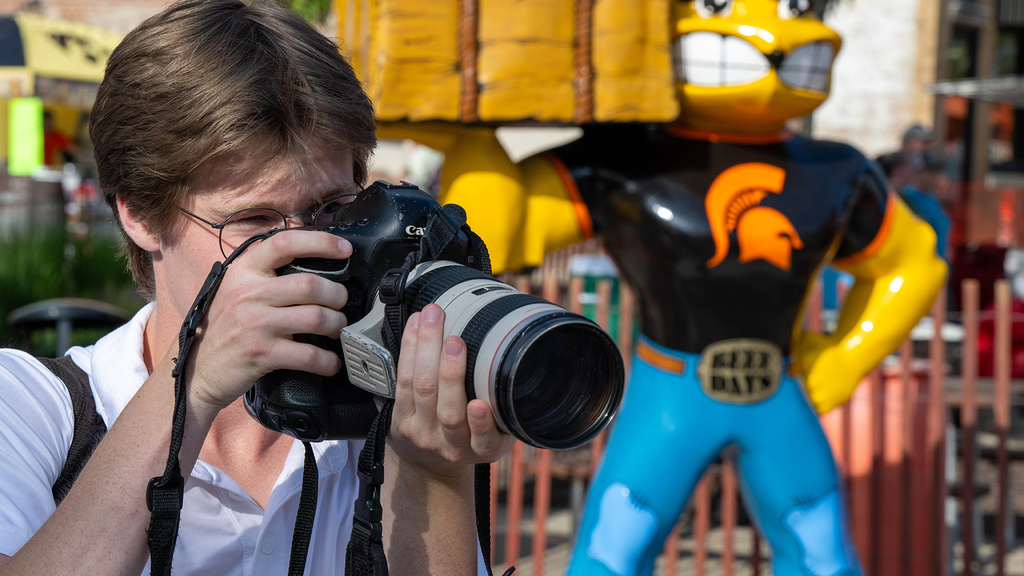
University of Iowa students took an ambitious art-and-science course into the field in Iceland, where high-altitude balloon launches tested their technical skills, creative instincts, and ability to work across disciplines in unpredictable conditions.
Story: Emily Nelson
Photography: Thalassa Raasch and Justin Torner
Published: Sept. 25, 2026
On a misty July day in Iceland’s Thingvellir National Park, which sits at the boundary where the North American and Eurasian tectonic plates are pulling apart, University of Iowa students huddled inside a bus, weather-proofing months of work.
Outside, gusts of wind swept across the landscape as another group filled a weather balloon with helium. Students moved back and forth between the bus and the makeshift launch area, sharing zip ties and tools, checking electronics, attaching tracking devices, and doing their best to keep sensitive equipment dry.
Then it was time to see whether any of it would work.
“They let the balloon go, but it didn’t have enough helium. So, it went up and just kind of started going sideways across the landscape,” says Clayton Salley, a recent Iowa MFA graduate. “I captured a neat video of it coming toward me, and then I grabbed the balloon as it was coming down so it didn’t hit the ground. I handed it back to the group, and they put more helium into it and off it went.”
The weather balloon launches were the culmination of the course, The Iowa Idea at Great Heights: Iceland Solar Eclipse High-Altitude Ballooning Project. The course was rooted in the “Iowa Idea,” the university’s century-old philosophy of connecting creative and scholarly work across disciplines.
In spring 2026, undergraduate and graduate students from engineering, physics, astronomy, environmental sciences, art, and education worked together to design, build, and launch near-space weather balloon payloads in Iceland as part of an ambitious interdisciplinary expedition.
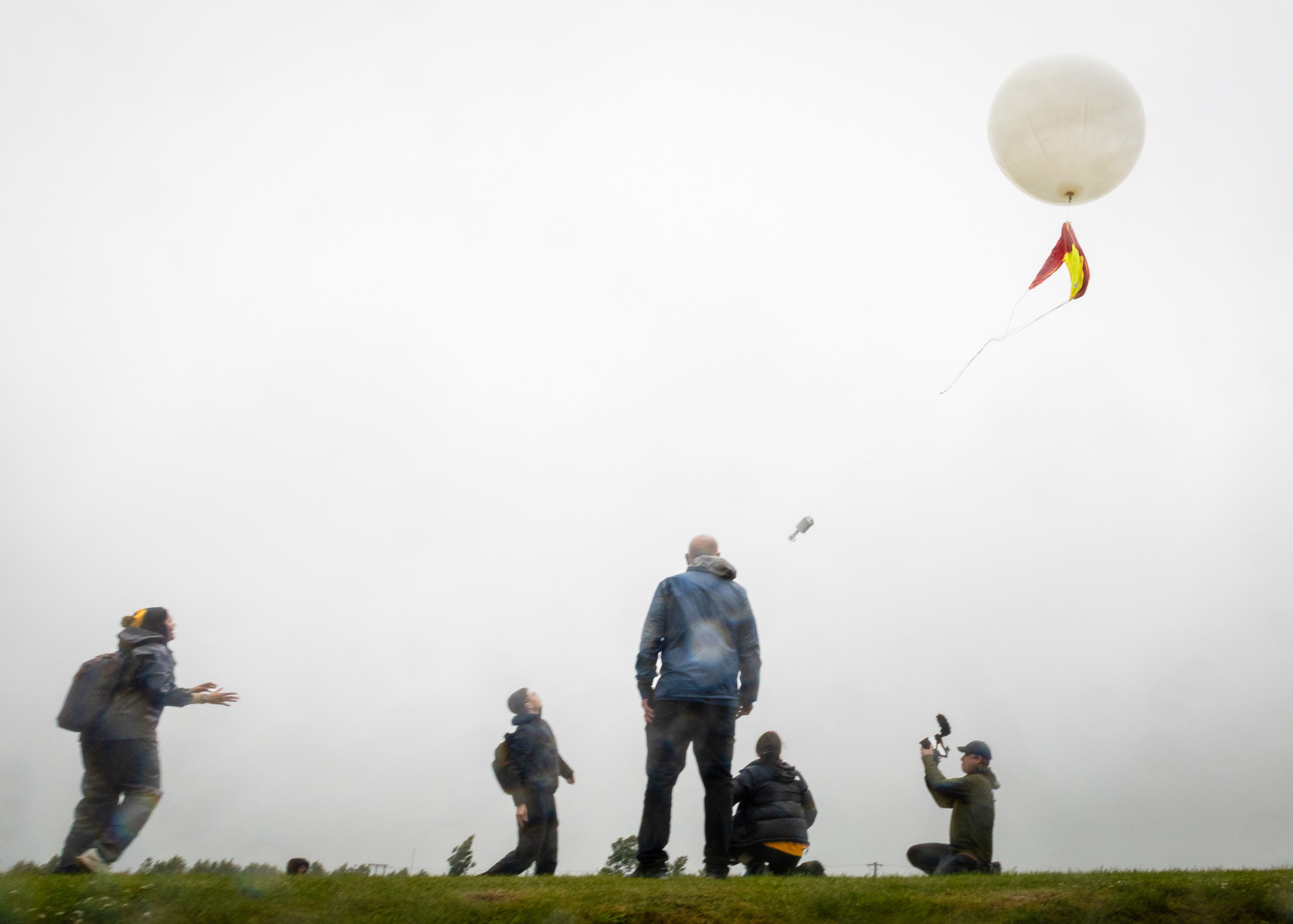
Members of the University of Iowa team watch a weather balloon ascend during their July expedition in Iceland. The launch put a semester of designing, building, and testing payloads to work in the field.
Their goal sounded simple: launch weather balloons into Iceland’s skies during the total solar eclipse and gather atmospheric, geological, visual, and artistic data.
What students learned, faculty and students say, is far bigger.
“This is the school of doing hard things,” says Steve McGuire, professor and area head of jewelry and metal arts in the College of Liberal Arts and Sciences’ (CLAS) School of Art, Art History, and Design, who developed the course alongside collaborators across campus. “Failure is always a possibility. But the process — learning to collaborate, to build, to adapt, to think across disciplines — that’s the point.”
A class built across colleges
The project grew out of McGuire’s multiple bicycle expeditions across Iceland and conversations about how to create a truly interdisciplinary learning experience.
McGuire admits he knew little about weather balloons before beginning to develop the class.
“I knew that they went up in the air,” McGuire says, laughing. “But I knew that I was mechanically inclined enough to work things out. But I began to learn, and I impressed my science teacher wife that I actually figured out a lot of stuff.”
McGuire knew he’d need buy-in from multiple faculty and departments across campus. He got it.
The course was listed through the College of Education, which had launched an interdisciplinary global education initiative designed to revitalize the Iowa Idea through collaborative, cross-disciplinary teaching and research. Additional resources, support, and faculty expertise came from multiple areas within the College of Liberal Arts and Sciences and the College of Engineering.
“A huge number of people and departments really came together for this,” McGuire says.

Reviving the Iowa Idea
The Iowa Idea at Great Heights: Iceland Solar Eclipse High-Altitude Ballooning Project evolved out of a uniquely Iowa concept: a course where students from radically different disciplines tackle the same problem from different perspectives.
The “Iowa Idea” is a philosophy dating back more than a century that brought artists and scholars together in an academic context. It was a revolutionary concept; for decades, institutions taught art and art history as separate disciplines. With the Iowa Idea, artists trained within a liberal arts environment that combined studio art courses with the history and theory of art. The idea caught on, and Iowa’s School of Art, Art History, and Design in the College of Liberal Arts and Sciences became the model for many arts programs around the nation.
That philosophy has become the backbone of the class. The students are embracing the concept.
“I’m fascinated by the ‘Iowa Idea,’” says Clayton Salley, who graduated in May 2026 with an MFA in metalsmithing. “Art and science are both trying to reveal knowledge, and at the risk of sounding very cliché, I have been drinking the Kool-Aid of this project more than a little bit.”
Steve McGuire, professor and area head of jewelry and metal arts in the School of Art, Art History, and Design, says Iowa is uniquely positioned to put the philosophy it created to work.
“The University of Iowa is the Goldilocks size,” McGuire says. “We’re big enough to have world-class expertise across fields, but small enough that faculty know each other and collaborate. That creates opportunities for students to work in ways that mirror how the real world actually functions.”

Steve McGuire speaks with students in The Iowa Idea at Great Heights, a course that brought together artists, scientists, and engineers to prepare for weather balloon launches in Iceland. The conversations bounced between design, climate science, coding, photography, geology, data visualization, and storytelling.
Building teams around skills, not majors
Students applied to join the class, explaining their interest in working on an interdisciplinary team and what expertise or skills they could contribute to the success of the project.
McGuire was blown away by the students who applied.
“I told my wife I don't even deserve to be in the same classroom as these students,” McGuire says. “They are so smart.”
Twenty-two students were chosen:
- 10 engineering students
- 6 art and art education students
- 5 physics and astronomy students
- 1 student double majoring in sustainability science and communication studies
In thinking about the weather balloon payloads, an engineering student may see instrumentation challenges. A physicist may focus on atmospheric measurements. An artist may see visual storytelling opportunities. A sustainability science student may see landscape analysis.
Together, those perspectives become something more complete.
“We wanted students to understand that no one person could make these payloads alone,” McGuire says. “The work becomes richer because of the collaboration.”
Students started with brainstorming exercises, and self-organized into project teams. Instead of assigning groups based strictly on academic disciplines, faculty asked students to identify their actual skills: coding, CAD modeling, photography, electronics, documentation, visualization, fabrication, storytelling, instrumentation, and communication.
The results surprised even the instructors.
“We discovered the skill sets didn’t always align with the fields,” says Stratis Giannakouros, director of CLAS’ Office of Sustainability and the Environment. “Some art students were highly technical. Some engineers were exceptional visual thinkers.”
Giannakouros says the students organized themselves organically and quickly: “They immediately identified the skills they needed and found each other.”

“This is the school of doing hard things. Failure is always a possibility. But the process — learning to collaborate, to build, to adapt, to think across disciplines — that’s the point.”
Finding a future in instrumentation
Sydney Tune, now a fourth-year student from Strafford, Missouri, majoring in physics and astronomy with minors in geoscience and mathematics, previously participated in Iowa’s Edge of Space Academy, run by CLAS’ Department of Physics and Astronomy, and was eager to continue hands-on atmospheric research.
Most of her previous research experience involved coding, she says. Building instrumentation and physically launching payloads offered an entirely different kind of learning.
“Edge of Space was the first project where I could actually make things with my hands,” Tune says. “This class allowed me to get even more experience while also taking on a different role.”
Her team developed a payload that combined custom-built spectroscopy, photogrammetry — the science of making reliable measurements using photographs — and environmental sensors to create detailed three-dimensional reconstructions of Icelandic landscapes from above.
The experience has altered Tune’s thoughts about her future career.
“I’ve found a new love of instrumentation,” Tune says. “I came to college planning to do pure astrophysics, but after Edge of Space and this class, I’d love to look at something more hands-on. I remember seeing people building spacecraft and thinking that would be so cool, but never something I could do. But now it’s something that I have experience in and doesn’t seem so far-fetched anymore.”
Participation in the class helped Tune land a spot on Iowa’s Deep Underground Neutrino Experiment (DUNE) team. The project is trying to unlock the fundamental mysteries of subatomic particles called neutrinos by sending an intense beam of them 1,300 kilometers — about 808 miles — straight through the Earth from Illinois to South Dakota to see how they change form.
“This class has obviously proved to be really good résumé experience,” Tune says. “I’ve worked on two different payloads now, which has given me a very broad set of skills, which is great.”

Physics and astronomy student Sydney Tune carries instrumentation at a launch site in Iceland. Building and launching payloads gave her a new interest in hands-on research.
Combining technical work with creative exploration
Early in her first year at Iowa, Abi Cahill went to an engineering career fair and realized she didn’t want to work on more traditional engineering projects.
“I wanted to build experiences,” says Cahill, who is from Elmhurst, Illinois. “I wanted to work in entertainment engineering and creative technology.”
Now a fifth-year industrial engineering student who is also pursuing a digital arts certificate, Cahill says she felt the weather balloon class aligned with the kind of career she hopes to build.
“I’ve been trying to combine art with engineering since high school,” Cahill says. “I hope there continues to be more opportunities like this class to push art and engineering and other students together to work on projects. There’s so much we can learn from each other.”
Her team’s project extended beyond traditional atmospheric data collection to include virtual reality, artistic visualization, and sound design. They used a 360-degree camera system to capture immersive footage from the balloon in Iceland with hopes to transform the footage and scientific data into a multisensory VR experience that allows viewers to experience the balloon flight during the eclipse.

Clayton Salley, who earned an MFA in metalsmithing, and industrial engineering student Abi Cahill work together at a launch in Iceland. The course asked students from different disciplines to solve problems in the field.
Exploring collaboration as an artistic practice
For Clayton Salley, who graduated in May 2026 with an MFA in metalsmithing, the class represented an opportunity to explore collaboration itself as an artistic practice.
His group explored ways to collect atmospheric data while also creating an object that functioned aesthetically — something that could communicate climate science emotionally as well as scientifically.
“We wanted the payload to exist as both an instrument and an artistic object,” Salley says.
The team drew visual inspiration from early moon-lander designs while exploring ways to represent scientific information through sculpture, exhibition, and storytelling.
“There’s a tendency in some environments to undervalue art,” says Salley, who became interested in interdisciplinary creative work while researching performance, dance, and wearable art in Taiwan. “But art and science are both trying to reveal knowledge.”
The course, he says, has challenged students to communicate across disciplinary boundaries and understand how others think.
“You realize quickly that everyone at the table has expertise you don’t have,” Salley says. “Learning how to collaborate with that is part of the experience.”
Salley says he appreciated every step of the journey.
“From the beginning, I understood the mantra of this project, which was ‘You don’t know how things are always going to go,’” Salley says. “And that’s OK.”
Three ways of seeing Iceland
The student teams approached Iceland from three directions: the upper atmosphere, the air around them, and the landscape below.
What if atmospheric science could also be experienced as an artwork? The Mission HAMMER team studied Earth's magnetosphere, gathering magnetic, pressure, and temperature data that students plan to turn into sound, visual environments, and immersive virtual reality.
The Troll's Breath team focused on Iceland's atmosphere, mapping greenhouse gases and other conditions while exploring the payload itself as a human-made artifact moving through a wild landscape to explore the tension between industry and environment.
Rock'n Trolls looked downward, using cameras, spectroscopy, photogrammetry, and environmental sensing to create detailed three-dimensional reconstructions of Icelandic landscapes from above. They are attempting to answer deceptively simple questions — What does Iceland look like from above? — while also merging imaging, remote sensing, engineering, and exploration into a new way of seeing landscapes.
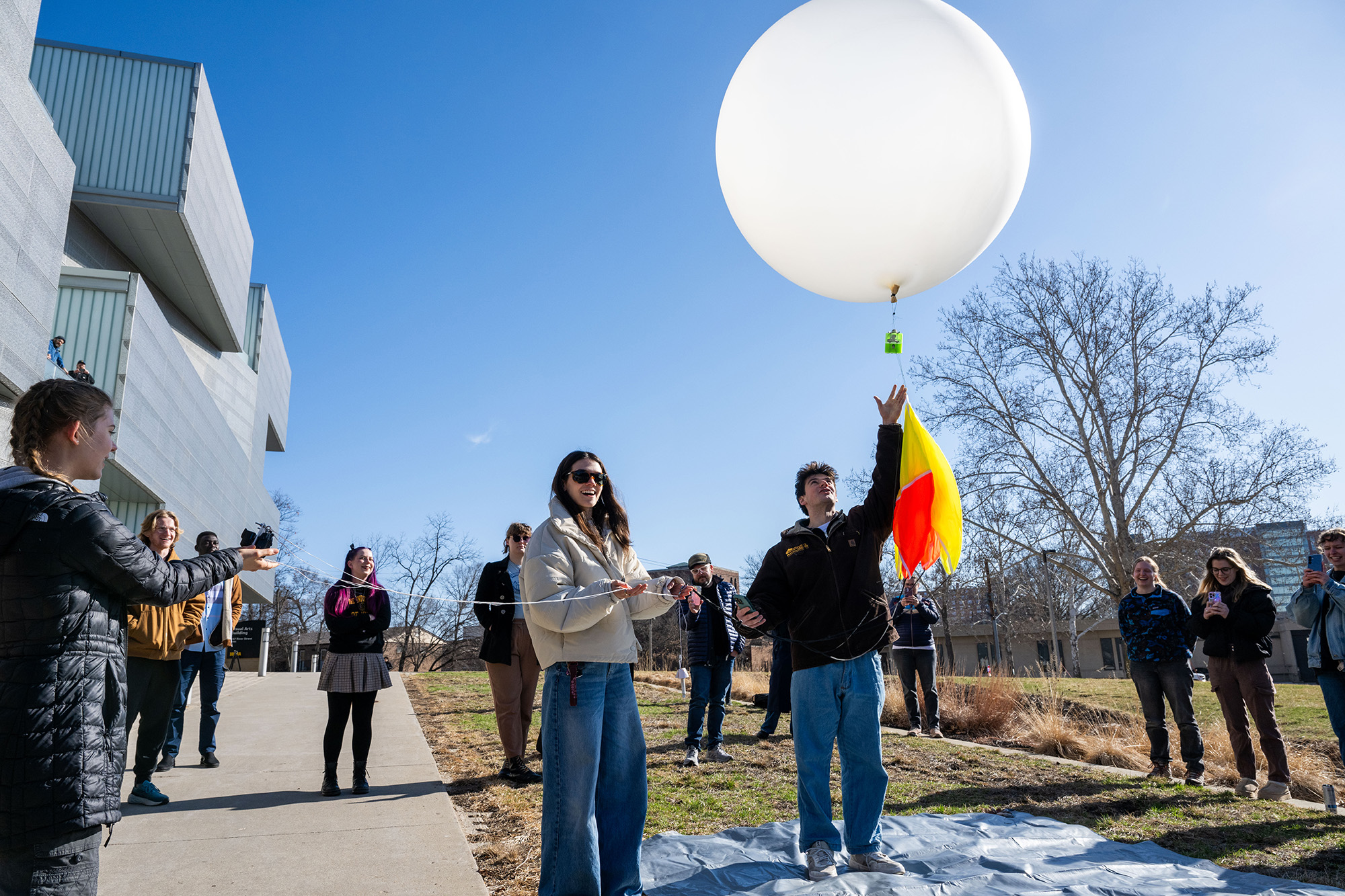
Students launch a test balloon on the University of Iowa campus before traveling to Iceland. An early equipment failure gave the team a chance to identify a problem and adjust its plans.
A classroom with no fixed address
The class moved constantly across campus, with students working in the Visual Arts Building, the College of Education makerspace, engineering facilities, and fabrication labs. That movement was intentional, McGuire says, because the course asked students to physically experience the interdisciplinary nature of the work.
Faculty members say that flexibility mirrors the reality students will face after graduation, when the ability to collaborate, adapt, and solve unfamiliar problems often matters as much as disciplinary expertise.
Joshua Weiner, professor of biology and associate dean for research and infrastructure in the College of Liberal Arts and Sciences, says the project reflects the broader purpose of a liberal arts education.
“The skills that are transferable are the ones that you need to problem-solve: collaboration, creativity, communication,” Weiner says. “You can look up simple information on your phone instantly. What matters is creativity, problem-solving, figuring out difficult things, and bringing together people with different perspectives.”
For McGuire, that also makes the course a powerful example of what Iowa can offer.
“What I would love to have happen is for students to see this and say, ‘That’s the kind of experience I want. I want to go to Iowa,’” McGuire says. “Or for a potential faculty member to see this and say, ‘That’s exactly the kind of place I want to have a career.’”

Learning when things don’t go as planned
Unlike many college courses, this one did not come with predetermined answers.
Students were designing systems that could fail. Weather could ruin launches. Instruments could stop functioning in extreme temperatures. Balloons could drift away or crash into glaciers.
Faculty embraced that uncertainty.
“We’re trying something new that has the potential to fail or to not go as planned,” McGuire says. “We’re building resiliency skills to deal with failure when it happens. Because in the real world, we have to fail along the way in order to succeed at the end.”
Kay Ramey, assistant professor of learning sciences and educational psychology in the College of Education, who studied the course as a researcher, says the project enabled students to engage in authentic problem-solving rather than simply completing prescribed assignments.
“Here’s a novel problem,” she says. “We don’t know exactly how we’re going to solve it. Even the instructors are figuring some of it out as we go.”
That ambiguity created opportunities for deeper learning.
“It’s not just the instructor giving assignments,” Ramey says. “Students have to embrace uncertainty and manage their own learning and collaboration.”
The students experienced unpredictability before they even left for Iceland. During an early test launch in Iowa City, a cut-down mechanism triggered too early, bringing the balloon back to earth sooner than expected.
Instead of viewing the launch as a setback, students treated it as data.
“It showed us exactly what we need to fix,” Tune says. “We were planning for failure. We were thinking about how to collect and save data even if we lose the balloon.”
When the students arrived in Iceland in July, all that planning for the unexpected was quickly put to the test against one of the world’s most dramatic and unpredictable landscapes.
Rainy, blustery weather greeted the group, and a narrow weather window meant there was little time to settle in. The students arrived in Reykjavík on July 10; the next morning, they were preparing for their first launch.
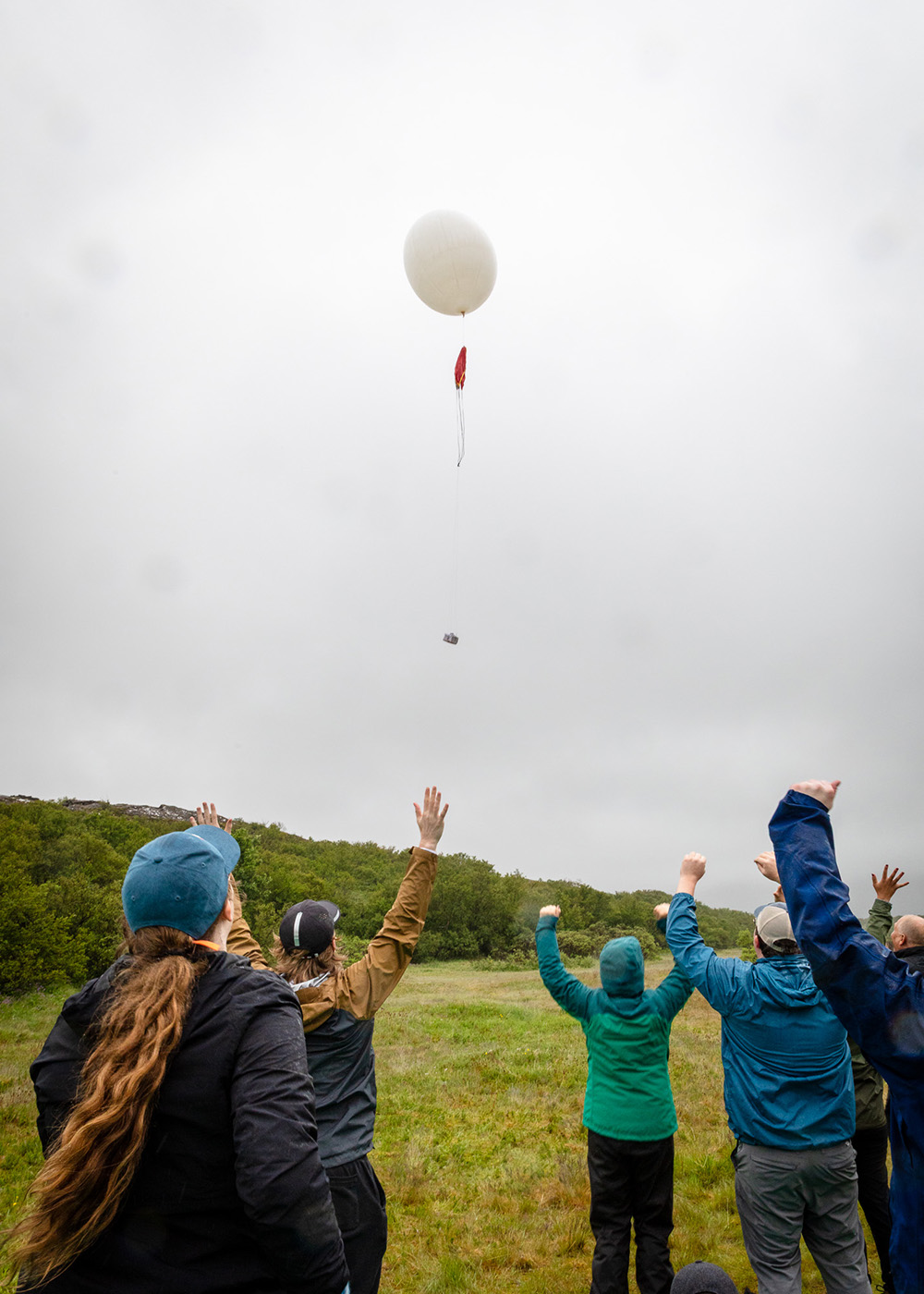
The Iowa team celebrates as a balloon heads skyward.
Over two days, the teams launched three balloons — one in Hella and two in Thingvellir National Park. They encountered the kinds of challenges they had spent the semester preparing for: wind, rain, equipment issues, difficult terrain, and the possibility that the payloads they had worked so hard to build might not come home.
After overcoming a few early glitches, such as the balloon with too little helium, McGuire says the students’ launches went off beautifully. One reached the stratosphere at an estimated 22 kilometers, or 70,000 feet.
Unfortunately, only one of the three payloads has been recovered so far. One came down on Europe’s largest glacier. Another landed miles from a road in challenging terrain. Tracking failed on another.
And when McGuire and a small group launched a balloon during the actual solar eclipse in August — the large student group was unable to travel to Iceland at the time due to the huge influx of tourists for the celestial event — its tracker eventually went silent, too.
McGuire connected with Icelandic climber Knútur Garðarsson through Knútur’s father, Iowa City resident Garðar Sigurðsson, who joined McGuire on a summer 2026 bicycle expedition across Iceland. McGuire and Knútur explored options for recovering two payloads whose locations were known. Knútur then connected McGuire with fellow climber Maksym Honcharenko, who made the long, difficult trek to recover one of the payloads in northern Iceland.
Still, the setbacks were real, especially after months of work.
“There was huge disappointment because there was so much enthusiasm around the outcome of their effort,” McGuire says.
But McGuire says what happened to any one balloon isn’t the best measure of what the project accomplished.
Instead, he thinks about what students did to get the balloons into the sky at all: They designed something. They built it. They tested it. They fixed problems. They depended on people whose expertise was radically different from their own. And then they took what they had made halfway around the world and tried it for real.
“It was kind of a marvel to watch,” McGuire says. “Getting the payloads recovered would just be the icing on top.”
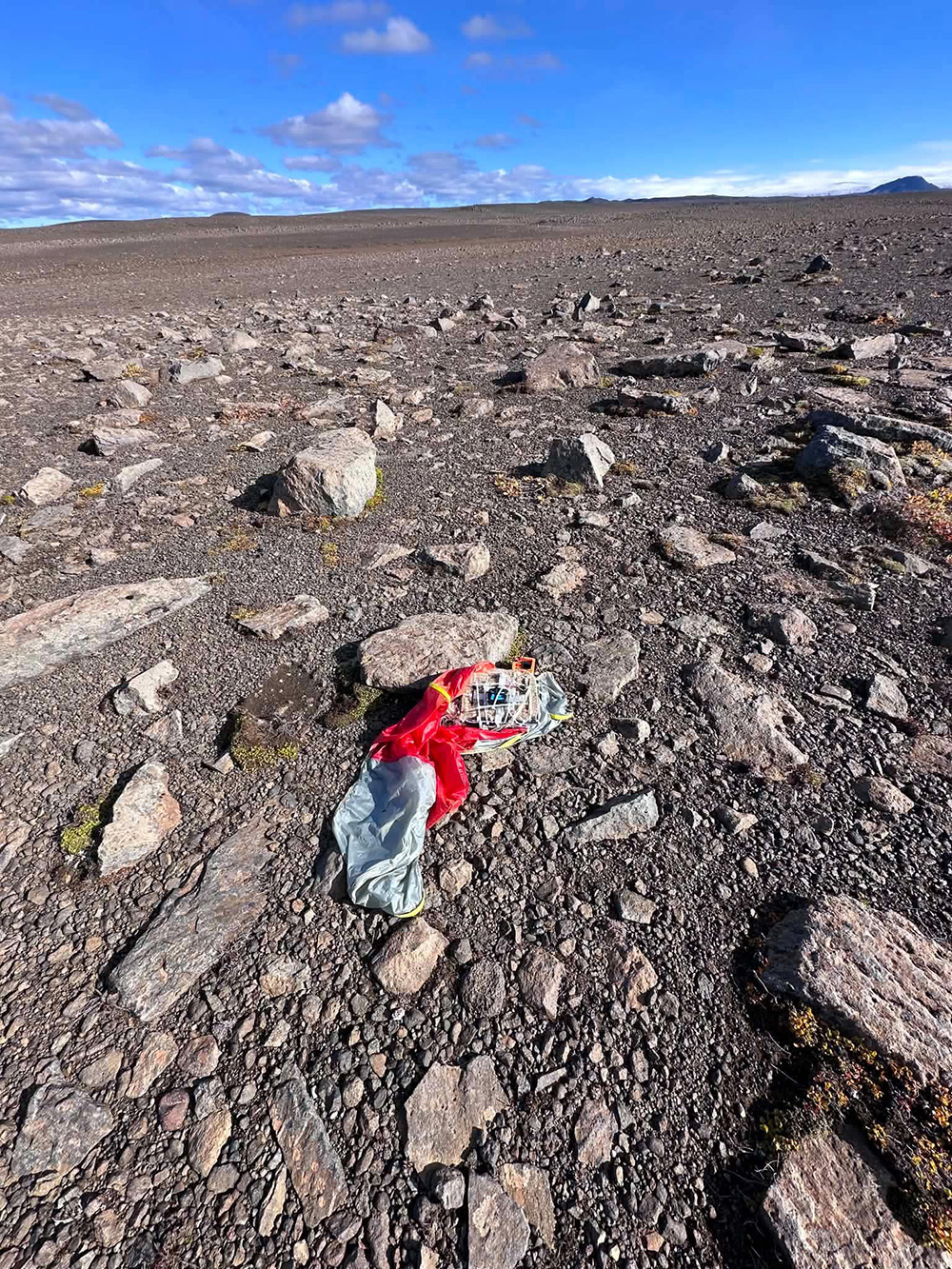
It took substantial physical effort, but this payload was recovered in northern Iceland.
Pedaling toward the eclipse
A related expedition continued the Iceland adventure into August.
A separate group of 12, including a few who had built their own bikes in McGuire’s bike-building classes, embarked on a three-week cycling expedition beginning in Akureyri. They followed the Iceland Divide through the remote Highlands, descended to the southern coast, and then turned west toward the Westfjords — roughly 650 miles of riding with a destination in mind: the path of totality for the Aug. 12 solar eclipse.
McGuire described the journey as a mission with a clear “destiny and destination”: launching a weather balloon during the eclipse.
Like the student launches, the ride demanded flexibility. The group encountered sandstorms and punishing winds, including one day when gusts topped 60 mph and conditions became too dangerous to ride.
“Every rider on the trip got blown over at least once,” McGuire says.
They ultimately reached the Westfjords and launched a weather balloon during the eclipse. Clouds obscured much of the view, but McGuire watched the moon’s shadow race across the cloud deck as the landscape grew dramatically dark. The balloon climbed toward the stratosphere before its tracker stopped transmitting.
For McGuire, the expedition echoed the lesson of the semester-long course: The value wasn’t simply reaching a destination or recovering a payload but what people learned by taking on something difficult together.
Beyond Iceland
Faculty agree the real success of the course would not be measured solely by recovered payloads or atmospheric data.
Instead, it would be measured by what students discover about themselves.
“I think students are realizing they’re capable of much more than they thought,” Ramey says.
And the relationships that began in a classroom continued in Iceland — on launch fields, in museums and bakeries, on hikes in driving rain, and around shared dinners back at the hostel.
“Everyone was very present and open to connecting with each other,” Salley says. “There was just something special about it.”
Cahill agrees.
“I’m interested in not only seeing how this class shapes us but the collaborations that come out after the class ends,” Cahill says. “Because I think they will. I really think they will.”
McGuire believes the most important outcomes may not become apparent for years.
“I think that they now have a marker in terms of their expectation for what they can get from a course and what they can do as a scientist or an artist or a designer or an engineer that pushes them forward,” he says.
“This is what education should be.”